
Artificial Intelligence
Future Telecoms
Life Sciences
Quantum
Robotics
Latest tech trends: what McKinsey says about quantum, robotics, connectivity and life sciences
Reading time: 6 mins
Why AI’s role in telecoms is no longer a question of if, but rather how fast, how safe, and at what cost?

Telecoms operators are under pressure from every direction. Revenue growth is flat, network complexity is rising, and the World Economic Forum projects that basic running costs will account for around half of a typical operator’s total OPEX by 2027. The talent pipeline is also thin. Legacy infrastructure is proving expensive to replace. And AI, for all the noise around it, is not a fix that will work overnight.
What it is, increasingly, is the basis for a fundamentally different operating model, and one that the industry can no longer afford to delay.
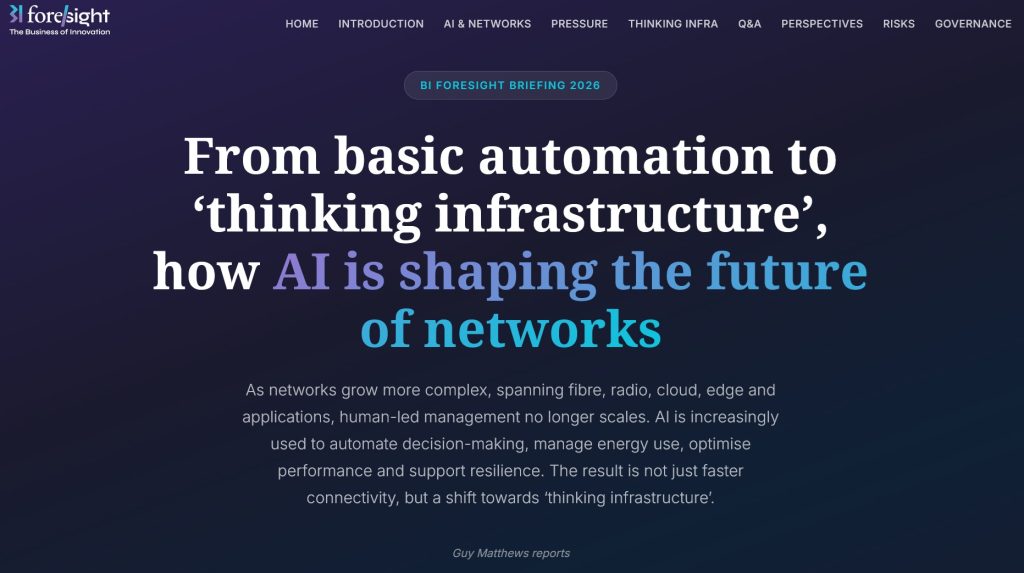
The latest BI Foresight briefing, Future Telecoms & AI: Shaping the Future of Networks, examines where that transition stands in 2026. What is working, what is overstated, and what operators must resolve before AI can move from pilot to production.
Deutsche Telekom has recorded efficiency gains of 20–30% from AI micro agents in network management. Rakuten has achieved 17% energy savings deploying micro agents in an Open RAN environment. Nokia reports 30% performance improvements with 99% less human effort. These are live results, not projections.
Legacy infrastructure, energy costs, a shortage of people who understand both AI and telecoms, and a persistent gap between conference demonstrations and production deployments are all slowing progress. Much of what is currently labelled agentic AI is, in practice, supervised learning on known workflows.
No operator will deploy AI it cannot audit, explain, and reverse on critical national infrastructure. The GSMA’s Responsible AI Maturity Roadmap gives operators a framework to assess where they stand. McKinsey puts the prize at up to $680 billion over 20 years, conditional on resolving governance.
The interactive briefing paper brings together voices from BT Group, Nokia, Omdia, Wayra Ventures, the University of Bristol and companies working at the frontier of AI and network infrastructure.
Read the BI Foresight telecoms briefing →
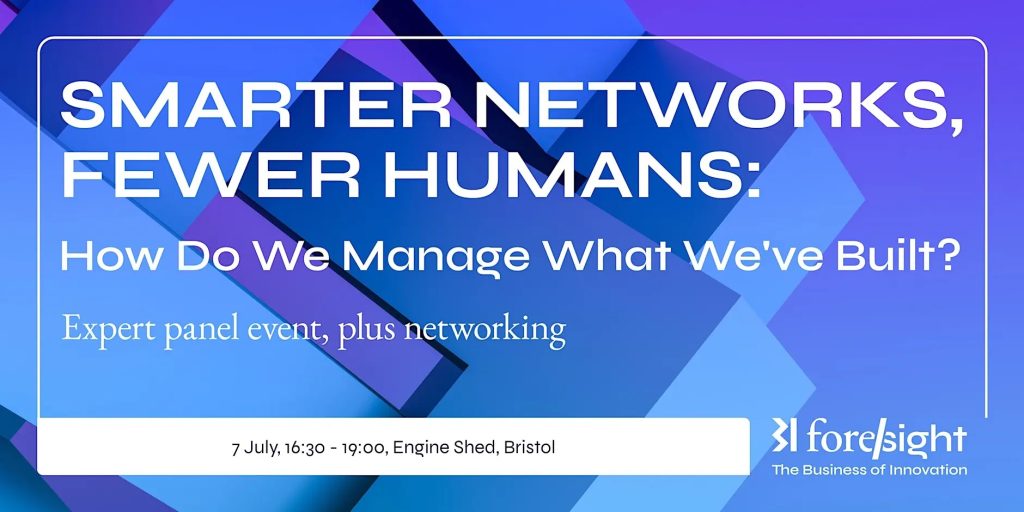
We also have a live event exploring this subject further and featuring some of the experts in the briefing. Click on the banner below for more information.
Guy has been a technology journalist for over 35 years during which time he has edited and written for numerous newspapers and magazines. A particular specialism for the past 20 years has been the market for wholesale telecoms services. As one of the main freelance writers for Capacity magazine, Guy has written in depth on topics ranging from developments in subsea cabling and the evolution of the Internet of Things to Carrier Ethernet standards and the challenges of network security. He has also contributed to European Communications, Mobile Europe, Vanilla Plus, IoT Now and The Register.