Artificial Intelligence
Future Telecoms
Quantum
Wise words and waggishness… September 2026
Reading time: 2 mins
The skills employers want most in quantum, robotics, connectivity, and life sciences, where the shortages are, and where the money is going

It will come as no big surprise that McKinsey’s Technology Trends Outlook 2026 trumpets the role AI is having on companies this year. But that’s not the whole story. While agentic AI tends to capture headlines (good and bad), AI is also having an impact on other tech innovation areas, says the report.
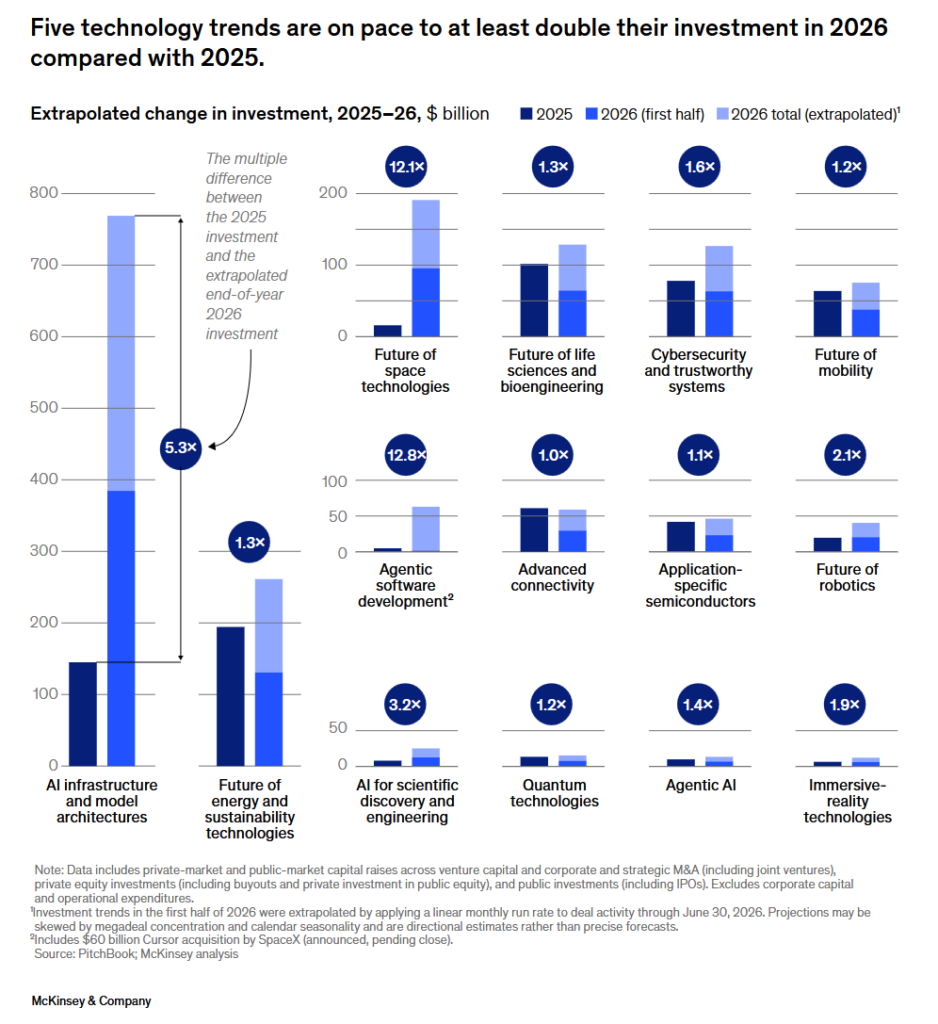
Of the four areas covered here, robotics raised a record $19.5bn in 2025 and, on first-half deals, is on course to double that this year. Quantum funding rose fivefold to $13.3bn. Life sciences held at around $100bn for a third year. Advanced connectivity, at $60.5bn, is the only one of the report’s 14 technology trends not on track to raise more in 2026.
Space outpaces all four. On first-half deals, its investment is on course for 12 times the 2025 total of $15.7bn, largely because SpaceX raised $85.7bn when it floated in June. SpaceX also drives the one bigger jump in the report, in agentic software development, through its $60bn purchase of the AI coding company Cursor.
McKinsey splits quantum into computing, communications, and sensing, each of which are at a different stage of development. Computing draws the most money and attention, but most business uses are still in trial and experimentation phases.
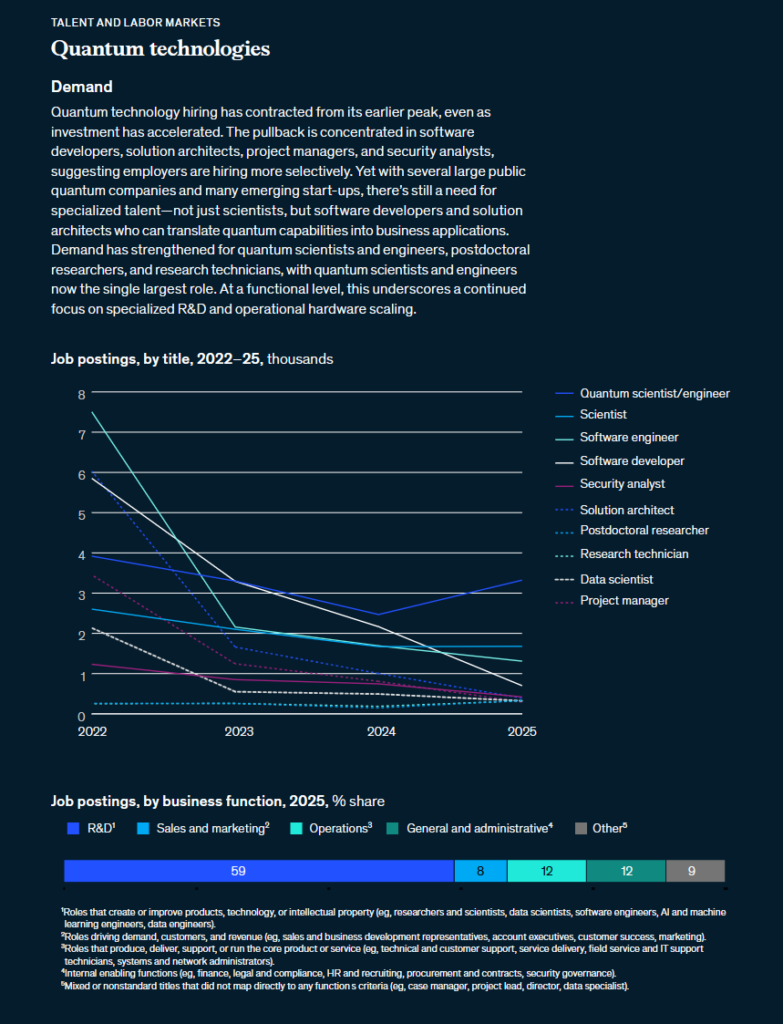
Investment rose from $2.5bn in 2024 to $13.3bn in 2025. Job postings fell 46% over the same period. Adverts for software developers, solution architects, project managers, and security analysts dropped, while demand rose for quantum scientists, postdoctoral researchers, and research technicians.
Communications and sensing are more advanced (take a look at Infleqtion, MSubs and the Royal Navy running a quantum optical clock on an autonomous underwater vehicle, last year, for navigation where satellite signals cannot reach), while cybersecurity continues to raise concerns and accelerate post-quantum cryptography. In June, the US government brought its deadline for switching to quantum-safe encryption forward from 2035 to 2031. Cloudflare says most human-initiated traffic on its network was already using it by October 2025. McKinsey adds that there is still no proof the new methods will hold against every future quantum attack.
Meanwhile, the reports says that more than 300 organisations, including Airbus, E.ON and JPMorganChase, are working with quantum companies on business problems. And governments are the biggest backers it seems, with the report citing $2bn of US manufacturing incentives and an extra €1bn from France.
Henning Soller, a McKinsey partner, says progress now depends on “integrating hardware, error correction, software, and classical computing into reliable systems that can solve real-world problems.”
McKinsey describes robotics as entering the era of “physical AI” and estimates that physical AI could create at least $1tn of value by 2040, most of it in manufacturing and logistics.
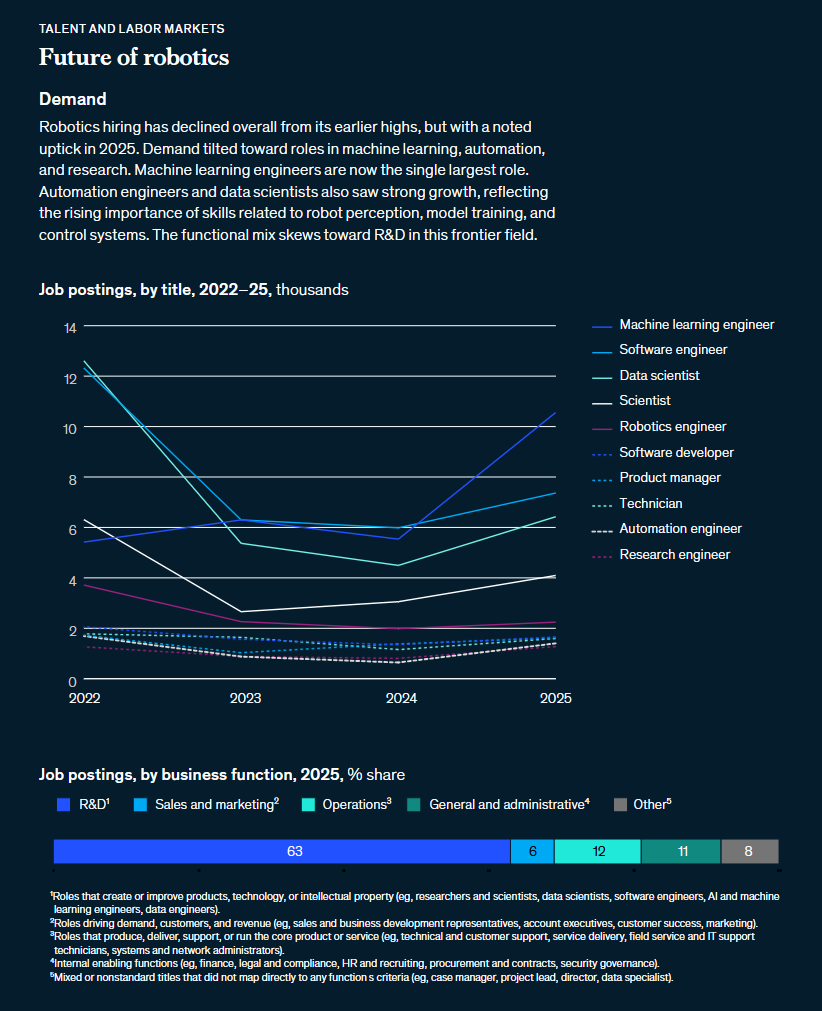
Investment reached a record $19.5bn in 2025 and, on first-half deals, is on course to double in 2026. Job postings rose 12%. Machine learning engineers are now the largest single role, and the scarcest skill is optimisation, which McKinsey calls central to making robots work in real settings.
Humanoid robots naturally draw a lot of attention. Shipments rose to 18,000 in 2025 and revenue grew more than 500% to $440m, with the Chinese firms Agibot, Ubtech and Unitree leading the way.
A humanoid robot costs $150,000 to $500,000, and McKinsey says few yet pass its tests for commercial use – lower cost, better dexterity, sustained uptime and safe operation without fencing.
Some manufacturers are testing wheeled designs instead. Siemens has trialled the wheeled HMND 01 at its Erlangen factory, and BMW is piloting the AEON at its Leipzig plant. China took 54% of new industrial robot installations in 2024 and has made robotics a priority in its 15th Five-Year Plan.
McKinsey expects most near-term value to come from fitting robots into existing factories and warehouses. Christian Jansen, a partner in Hamburg, says the market will be won “less by the impressive demo than by making these systems reliable enough for everyday operations.”
McKinsey’s advanced connectivity trend covers 5G and emerging 6G, Wi-Fi, fibre, low Earth orbit (LEO) satellites, and AI-managed networks. After a decade spent expanding coverage, it says the work now is in making these systems run together reliably and securely.
AI is changing what networks carry. As AI moves into factories, shops, vehicles, and phone masts, it needs lower latency and more upload capacity. Ericsson found generative AI accounted for 26% of uplink traffic, against about 10% in typical mobile networks.
Investment was $60.5bn in 2025, below its 2022 peak of $73.8bn, and connectivity is the only one of the 14 trends not on track to grow in 2026. It still leads on patent filings though.
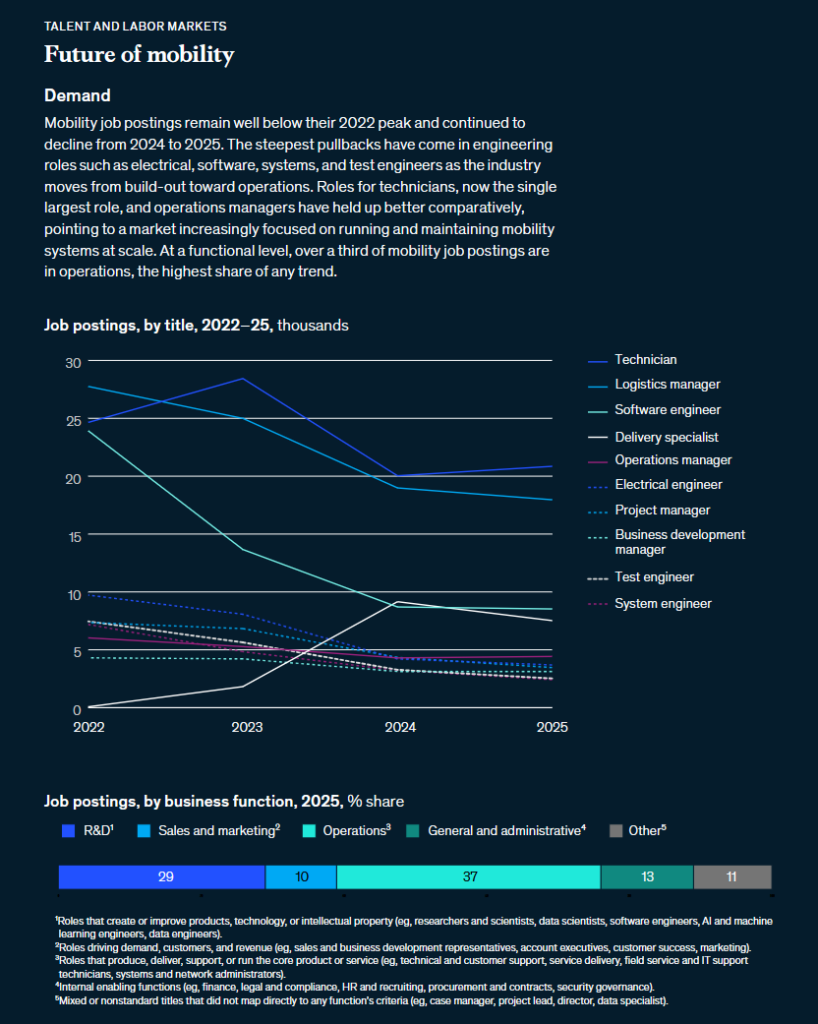
Job postings rose 10%, with the growth in sales, technical support, and other customer-facing roles. Research made up 38% of adverts.
Operators are looking for revenue beyond basic connectivity. A 2025 McKinsey survey found enterprises planned to raise spending on core connectivity by 3.2%, against more than 6% on other telecoms services. Network slicing, which gives a customer a dedicated part of a 5G network with guaranteed performance, is moving into early commercial use. The report cites Verizon in the US and Vodafone Business in the UK, which launched in April.
Satellites are also becoming part of the network. Starlink had almost 10,000 active satellites by August, and operator executives expect LEO services to take close to 20% of the market for existing fibre, mainly in hard-to-reach areas.
Anton Lysenko, an associate partner at McKinsey, says “as AI workloads become more distributed, networks become part of the compute infrastructure itself.”
McKinsey groups life sciences and bioengineering together, covering drugs, gene editing, cell therapies, diagnostics, precision fermentation, agriculture, and industrial materials. It says the field has “moved past the hype phase” pointing to gene-editing therapies that can now cure some patients with sickle cell disease. The test now is execution.
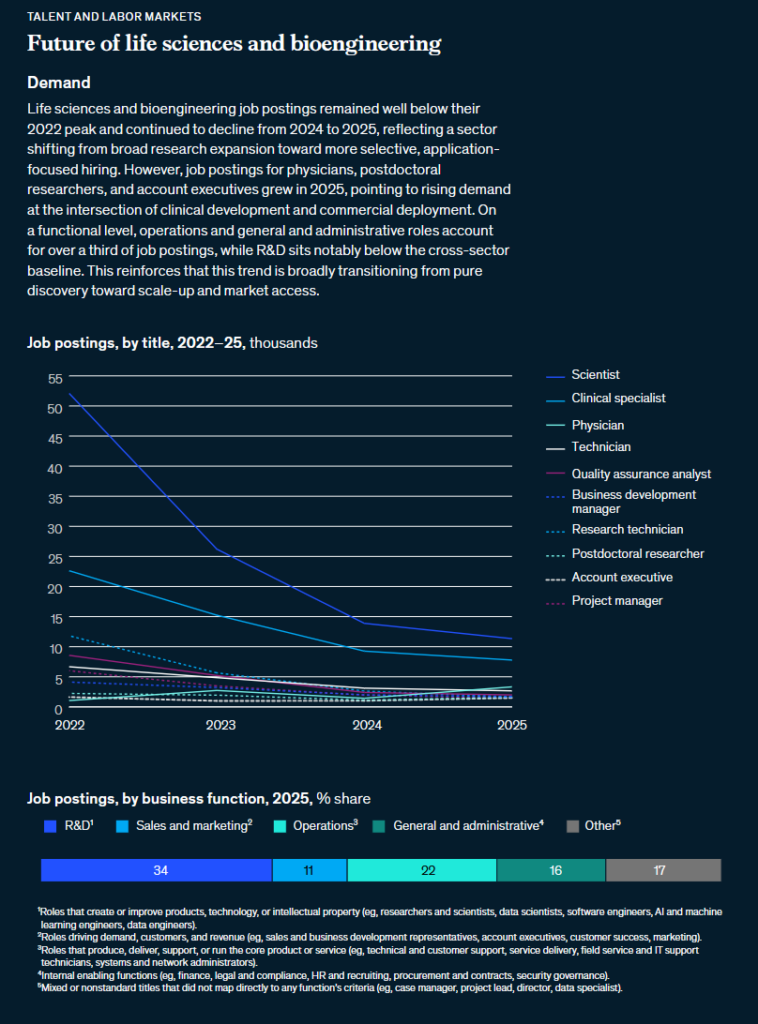
Investment was $101bn in 2025, roughly level for three years, and on first-half deals is on course for 1.3 times that in 2026. Job postings fell 10%, though demand grew for physicians, postdoctoral researchers and account executives. Research made up 34% of adverts, and the report finds talent is not a constraint.
AI is speeding up the early part of drug development. Researchers use it to design proteins, find possible drugs and read genetic data. The slower stages that follow have not changed – every candidate still needs lab testing, clinical trials, regulatory approval, and a way to be made at scale. McKinsey says AI can lengthen that queue, because it produces more promising candidates than labs and regulators can handle.
Even an approved treatment can be slow to reach patients. Casgevy, the first approved therapy using the gene-editing tool CRISPR, treats sickle cell disease by editing a patient’s own cells. In 2025, 147 patients had cells collected to begin treatment and 64 had the edited cells infused back. McKinsey says manufacturing and reimbursement held it back.
Some diagnostics are already in routine care. The report points to NHS England’s wider use of blood tests that detect tumour DNA, which help match cancer patients to the right treatment. It adds that the evidence for these tests is still mixed.
Erika Stanzl, a McKinsey partner in Zurich, says the companies that do well will be those that link AI to lab and clinical data and rebuild their whole development process around it.
Source: McKinsey & Company, Technology Trends Outlook 2026 (September 2026). Third-party figures, such as Ericsson’s traffic data and Vertex’s Casgevy numbers, are as cited in the report.
Working as a technology journalist and writer since 1989, Marc has written for a wide range of titles on technology, business, education, politics and sustainability, with work appearing in The Guardian, The Register, New Statesman, Computer Weekly and many more.