
Artificial Intelligence
Future Telecoms
Quantum
Wise words and waggishness… September 2026
Reading time: 2 mins
As the UK switches off 3G and EE’s 4G network turns 14, vendors and researchers get to grips with what the next generation should bring

The UK’s mobile operators are switching off their 3G networks this year, more than two decades after 3 launched the country’s first 3G network in 2003. Sold as a video-calling network, 3G, while technically capable never really lived up to its hype. Expensive handsets and poor network coverage meant that operators were always going to struggle to earn back the vast fortunes ploughed into 3G licences.
According to Paolo Pescatore, analyst and founder at PP Foresight (speaking to The Register in December 2025), 3G was “one of the most overhyped network technologies with unmet expectations,” and that 4G, “addressed the shortcomings of 3G.”
Clearly, 3G won’t be missed much, but as the 4G network, (launched by EE in 10 cities across the UK including London and Bristol in 2012) approaches its 14th birthday, on 30 October, the record looks a little different. Yes, there was hype but this tended to be around the importance of the network to national infrastructure. Its biggest promise was faster mobile broadband and it arrived roughly on schedule.

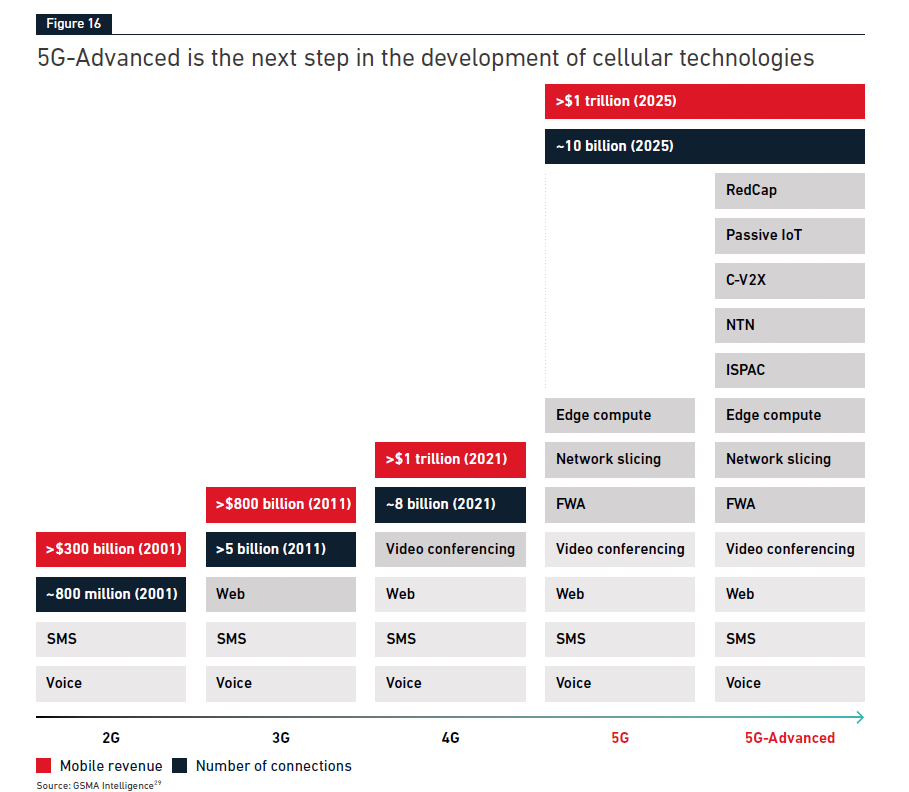
Five years later, 5G reverted to the old pattern. Launched commercially by South Korea in April 2019 and by EE in the UK that May, it was sold on remote surgery, driverless cars and smart cities that could manage their own traffic in real time. None of them arrived.
“Progress on speed, capacity, and latency was real, but some of the broader enterprise narrative moved more slowly than the industry initially suggested,” says Nokia’s John Harrington, whose company supplies network infrastructure to operators worldwide.
Five years on, only a fraction of the world’s 5G networks have gone Standalone, the version of 5G that is actually capable of the low-latency features that were promised at launch.
Whether 5G counts as a promise kept depends on where you’re standing. GSMA Intelligence’s State of 5G 2026 report scores the UK 59 out of 100 on its Connectivity Index, which is mid-table, behind leaders such as Kuwait (76), the UAE, Qatar, and Finland (72 apiece). The gap between nations comes down to Standalone 5G, and more than 80 operators worldwide have launched it, but only six markets have adoption above 10%.
Where it has been switched on properly, there is a marked difference in performance. Non-Standalone networks (which most of the world still runs) don’t support network slicing, guaranteed low latency or live broadcast at all. GSMA predicts that Standalone could lift mobile revenues by up to 5% by 2030 through enabling those services.
But this is also about money, of course. Between 2023 and 2025, GSMA Intelligence’s affordability index rose from 70 to 80 as data and device prices fell. Over the same period, its revenue growth index barely moved, sitting at 41-42 throughout. What that means is that networks got cheaper and faster, with operators making little to no more money from them.
That gap between technical capability and commercial reality is one the industry is now trying to close before 6G even arrives. In December 2023, the ITU set out the proposed scope for 6G, under the name IMT-2030. There are six scenarios including holographic and immersive communication, network-based sensing, AI-native infrastructure, near-total device density, wider satellite coverage, and ultra-low-latency control.
Some of this is a little reminiscent of 4G’s promise and almost exactly like 5G, but Nokia’s John Harrington argues the industry shouldn’t wait to find out which is which. His company launched what it calls the industry’s first commercial AI-RAN platform on 15 July 2026, built to run on 4G and 5G infrastructure operators already own, rather than waiting for new 6G hardware.
Nokia says the platform has already delivered more than 20% spectral efficiency gains on existing networks, with a target of 50% by 2027 and over 100% by 2028.
The idea is that these gains carry forward. Nokia designed the same platform to support “future 6G workloads” as the standard develops, so operators see measurable value now instead of waiting for a single 6G launch date.
“6G must not be 5G with a new label,” says Harrington.
Of course, Nokia wants it both ways. It wants continuity, so value builds now on infrastructure operators already own, and a genuine leap, big enough to justify calling it a new generation at all.
For Ross Devereux, of billing platform vendor Lifecycle Software, one unwieldy problem that needs addressing, and urgently is charging and billing. Operators can now offer dynamic network slices, real-time quality adjustments and moment-based pricing (the granular services 5G Standalone promises) but most billing platforms still work in the same flat, monthly-plan terms they used for 4G. His argument is that 6G will make this worse before it makes it better.
“If 6G enables new, more granular services, billing and charging systems will need to handle a level of complexity we haven’t seen before,” he says.
It’s one of many debates still ongoing. As with any shift from a legacy system, there are going to be growing pains. But it is convergence that is really driving complexity. Networks are now so much more than telecoms.
That idea raises questions around standards and not everyone thinks a new generation is worth building at all, let alone spending valuable time on arguing over the standardisation.
“I’m not too keen on 6G,” says Simon Fletcher, CEO at Real Wireless. “I think it’s a disaster, and the sooner the industry kills it off, the better for everyone.”
His argument isn’t that 6G, at least as a standard network, is not needed. He says there are already some interesting experiments underway and that they are “5G-Advanced stuff. They don’t require 6G standards to make it, to create value.”
Fletcher says his gut tells him that there will be a bunch of global 6G standards, not one, and that people “will pick and choose for their markets.”
For Professor Dimitra Simeonidou, Director of the Smart Internet Lab and Founding Director of the Bristol Digital Futures Institute, it’s not about 5G versus 6G at all, it’s AI for networks against networks for AI.
Simeonidou has spent the past several years working on REASON, a completed University of Bristol-led research project bringing together Samsung, Nokia, Ericsson, BT, Telefónica, and Deutsche Telekom, whose explicit aim was “to shape the future of 6G telecommunications by pioneering AI-driven, open and interoperable network solutions.”
“There’s very little about a network that doesn’t use AI, to some extent,” she said recently in the briefing paper From basic automation to ‘thinking infrastructure’, how AI is shaping the future of networks. “Does this mean that the whole system end to end is optimised by AI? No, not yet it doesn’t. What we have is a lot of different AI-optimised elements that sit side by side.”
It’s an indication of how far networks have come and also how differently people define progress. Promise less, deliver more? If there’s a lesson to learn from previous generations, then surely that is it.
Working as a technology journalist and writer since 1989, Marc has written for a wide range of titles on technology, business, education, politics and sustainability, with work appearing in The Guardian, The Register, New Statesman, Computer Weekly and many more.