
Artificial Intelligence
Future Telecoms
Quantum
Wise words and waggishness… September 2026
Reading time: 2 mins
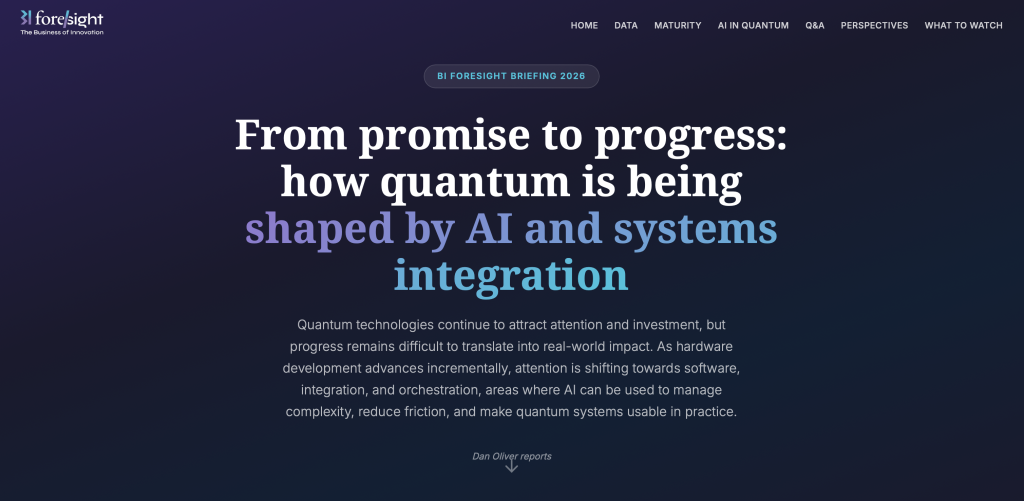
Quantum technologies continue to attract attention and investment, but progress remains difficult to translate into real-world impact. Is AI the answer?

Quantum computing is attracting serious money again – over $5 billion in 2025 – and the roadmaps from IBM, Google, Quantinuum and IonQ all point toward fault-tolerant systems by 2030. The questions are: who benefits; when; and is the current wave of investment priced on reality, or on hope?
Get the direction of the AI relationship wrong and you will misjudge both. The dominant narrative that quantum will turbocharge AI is, for now, running well ahead of the evidence. However, as Robert Sutor, who ran IBM’s quantum commercialisation programme, points out, AI has an increasing role. He describes it as noise-cancelling headphones: identifying interference and subtracting it so that a useful, stable signal can get through.
There are already working examples. IBM’s Qiskit Runtime is in production use for error mitigation, while Google’s AlphaQubit uses a transformer-based decoder that outperforms existing algorithmic approaches on error correction. But these are operational gains rather than breakthroughs. AI is keeping quantum systems stable and manageable. It is not yet making them transformative.
Brian Hopkins, VP of Emerging Technology at Forrester, says AI isn’t driving quantum breakthroughs yet. “Instead, it’s helping improve algorithms and hybrid workflows. AI-enhanced hybrid solvers are the most realistic near-term path to early quantum utility,” he says.
Which raises the obvious question: will AI actually accelerate quantum development, or just help manage its current limitations?
The vendor roadmaps all converge around 2030, but independent analysts are more cautious. Forrester puts practical utility at 2030 at the earliest; McKinsey puts meaningful commercial value in the early-to-mid 2030s.
Noah Linden, director of the Bristol Quantum Information Institute, says plainly, “the right question is not what can a quantum computer do now that a digital computer can’t. We’re fighting a battle between quantum computing in 10 or 15 years, and what we will have achieved in AI technology in that time. And it’s unknown.”
One deadline, however, that is slightly less speculative is Q-Day – the point at which a quantum computer could crack RSA-2048 encryption. It has a roughly 50/50 chance of arriving by 2030, according to Forrester. NIST published its post-quantum cryptography standards in 2024. For most organisations, this is the quantum problem that needs addressing now.
The BI Foresight briefing, From promise to progress: how quantum is being shaped by AI and systems integration, draws on interviews with Robert Sutor, founder of Sutor Group and former VP of IBM Quantum; Brian Hopkins, VP of Emerging Technology at Forrester; Anthony Laing, CEO at Duality Quantum Photonics; David Grimm, partner at AlbionVC; and Professor Noah Linden, director of the Bristol Quantum Information Institute.
Read the briefing: From promise to progress: how quantum is being shaped by AI and systems integration
Dan Oliver is a UK-based technology and design journalist with 25 years of experience. Dan has produced content for numerous brands and publications including The Sunday Times, TechRadar, Wallpaper* magazine, Amazon, Microsoft, Meta, and more.