
Artificial Intelligence
Future Telecoms
Quantum
Wise words and waggishness… September 2026
Reading time: 2 mins
Worth £18.5bn, growing at four times the rate of UK manufacturing, and central to the quantum technologies that governments around the world are now racing to build. The foundations of the photonics industry were laid in Britain

When Jeremy O’Brien and his University of Bristol team of physicists and engineers published a paper in Science in May 2008, showing for the first time that quantum logic operations could be performed on a photonic chip, O’Brien described it as “a crucial step towards a future optical quantum computer.” Eight years later he co-founded PsiQuantum, now the world’s most funded photonic quantum computing company.
This breakthrough moment added to the UK’s history in photonics technology, which goes back to Barr and Stroud’s pioneering optical rangefinder work in the 1880s, and Charles Kao and George Hockham’s 1966 paper, which laid the theoretical foundation for fibre-optic communications. But having a good history in photonics does not give the UK any right to its future.
Today, Britain is the second largest manufacturer of photonics in Europe, and ninth in the world. And yet its share of global investment in photonic quantum computing, the modality its own researchers helped create, is just 3%.
The UK photonics industry produced goods and services worth £18.5bn in 2024, according to Photonics UK. It employs 84,800 people across more than 1,400 firms and has grown at a compound annual rate of 4.4% over the past 12 years, which is four times faster than UK manufacturing as a whole. It also employs as many people as automotive or aerospace production, and more than three times the number employed in steel.
The sector is, in the words of Photonics UK, “a hidden economic engine” and is projected to exceed £1 trillion by 2030. But how much of that industrial strength translates into the quantum technologies that will define the next decade of computing?
Is the UK about to miss out on what is being touted as a key future technology, or is it perhaps well placed to be the engine room, the key supply chain for quantum regardless of modality? After all, photonics is not just one of five competing quantum hardware platforms, it is the infrastructure that all of them depend on.
“Cornerstone, you are killing it, because the entire quantum industry is going to require photonic integrated circuits.”
The comment came unprompted during a quantum computing panel event, says Andy Sellars, director of strategy at Cornerstone, with a smile. “He did all my selling for me,” he adds, while talking about the open-access silicon photonics foundry at the University of Southampton that he helps run.
Cornerstone could indeed be in a strong position, but it also reflects the UK’s wider ambitions. The quantum computing industry is currently fragmented across competing hardware platforms (trapped ion, photonic, neutral atom, and superconducting) but what is becoming clear is that photonic components will be increasingly important regardless of which platform prevails.
“What is unique about photonic integrated circuits is that they are the most scalable and the most mature of the platforms,” says Sellars. “Even if you’re going to use one of the other platforms, you still need photonic integrated circuits to process the photons or to guide the photons.”
Pete Shadbolt, co-founder and chief scientific officer of PsiQuantum, told BI Foresight in April 2024 that photonics was chosen partly because the supply chain already existed.

“It turns out that you can make chips where what moves around on the chip is light, instead of electricity,” he said. “This is photonics. It was originally developed by the telecoms industry for networking.”
Ruth Oulton, professor of Quantum Photonics at the University of Bristol, sees the dependency extending further still. Photonics, she says, will be needed for laser control in ion and atom systems, for interconnects between quantum processors, and for the classical switching technology that controls quantum computers.
“It’s going to be a widespread essential underpinning technology across most areas,” says Oulton.
And for Richard Murray, CEO of ORCA Computing and former director of the UK’s national quantum technologies programme, photonics is a technology that is only going to get more popular.
“Increasingly large computing systems are incorporating photonics to achieve scale up, scale out and scale across,” says Murray. “Photonics isn’t alien to the market and the users that we are targeting.”
A bit like O’Brien and Shadbolt at PsiQuantum, Murray built ORCA on that logic, using existing telecoms-grade supply chains rather than building new ones from scratch. The implication is that photonic components are already being designed and built in the UK, and that bodes well for its future role in a global quantum industry.
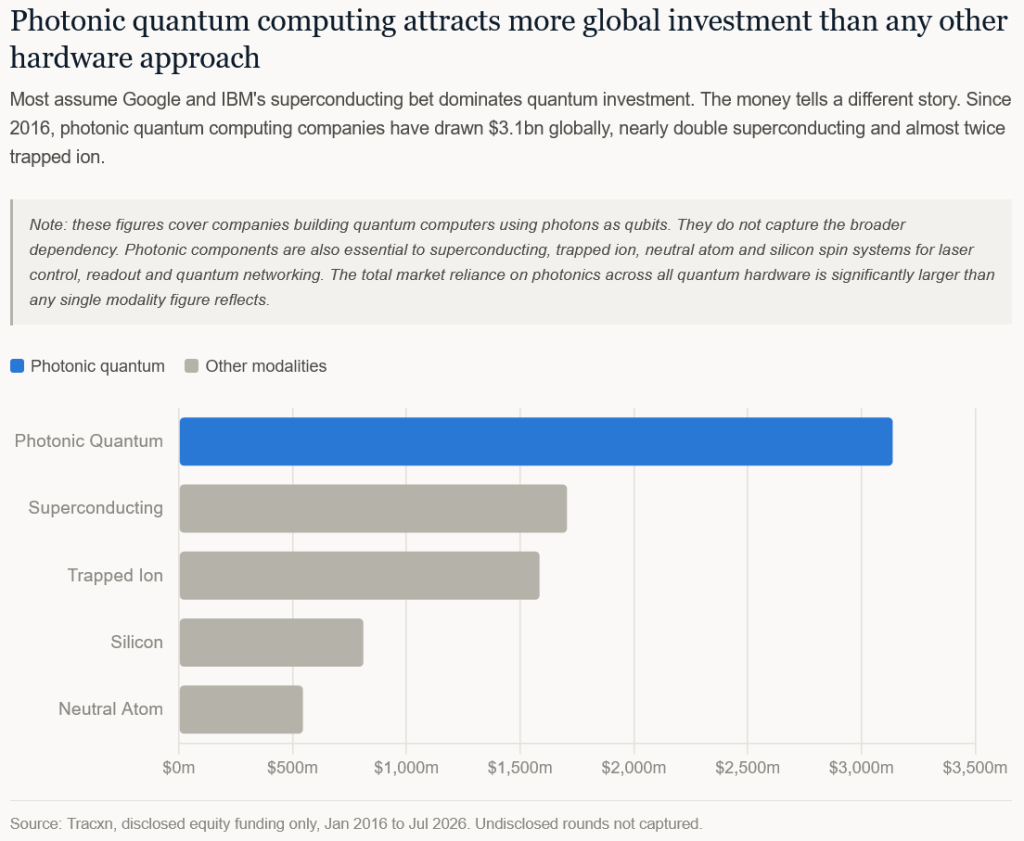
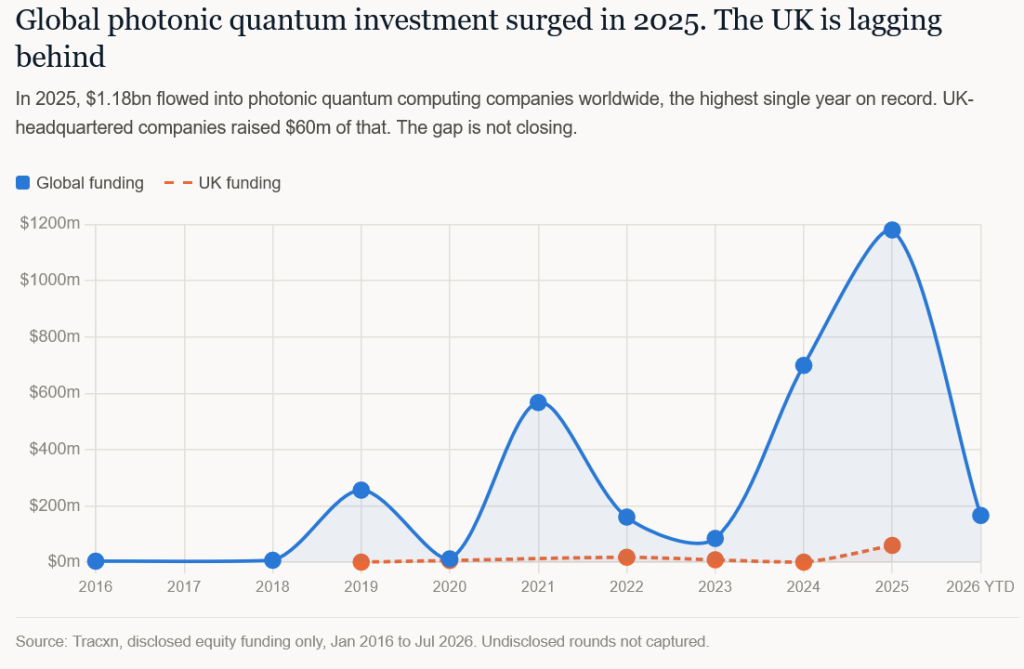
Analysis of disclosed equity funding using Tracxn data, covering January 2016 to July 2026, shows that photonic quantum computing companies have attracted $3.1bn globally across 70 rounds, more than any other quantum hardware modality. Superconducting attracted $1.7bn. Trapped ion $1.6bn. In 2025 alone, $1.18bn went into photonic quantum companies worldwide, the highest single year on record and nearly double the previous year’s total.
The UK’s share of that 2025 surge was $60m.
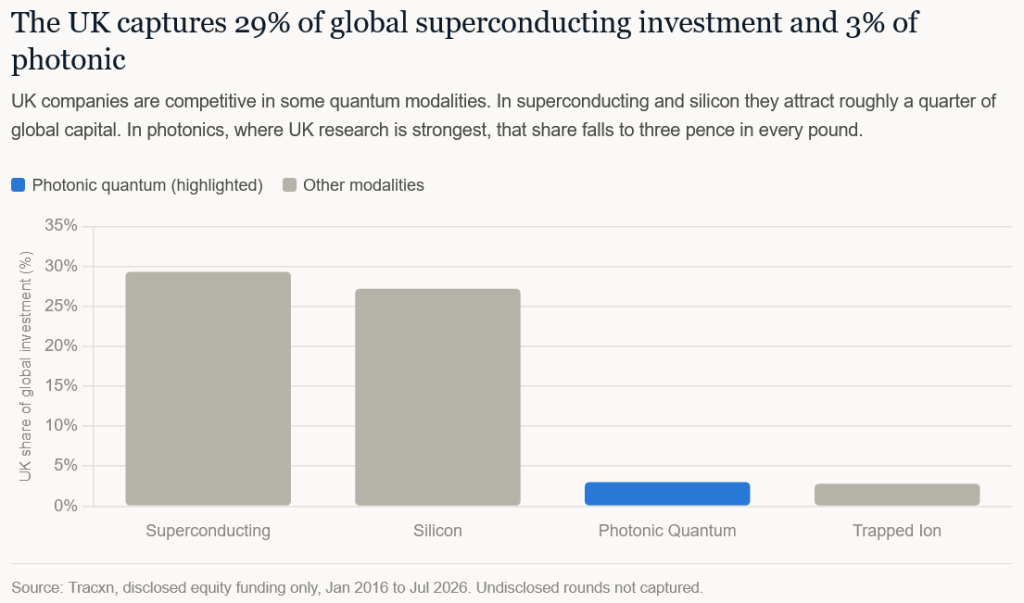
The same analysis shows the UK’s position within the global race is uneven. In superconducting quantum computing, UK companies attract 29% of global investment. In silicon spin qubits, 27%. In photonic quantum computing, the modality where UK research is strongest, that share is just 3%.
McKinsey’s Quantum Technology Monitor 2026 puts total global quantum technology investment at $12.6bn in 2025, a sixfold increase from the year before. The value at stake for industry from quantum computing is estimated at between $1.3 trillion and $2.7 trillion by 2035. No dominant modality or player has been established.
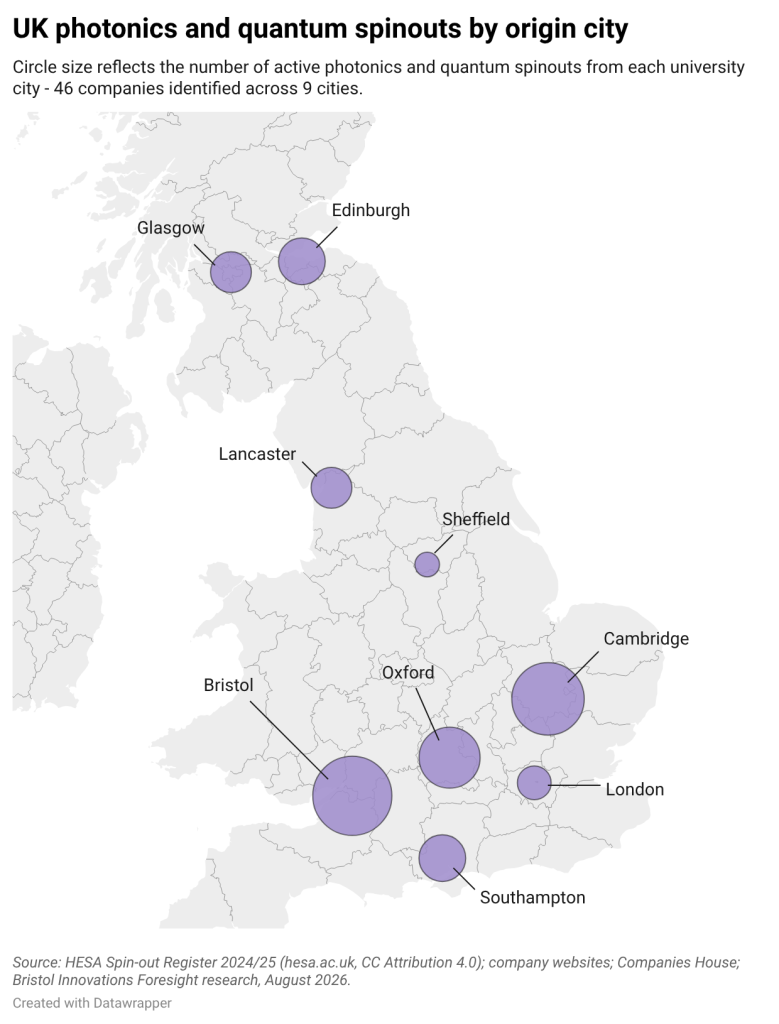
The translation of British photonics research into commercial companies has happened, with unusual concentration, in two cities.
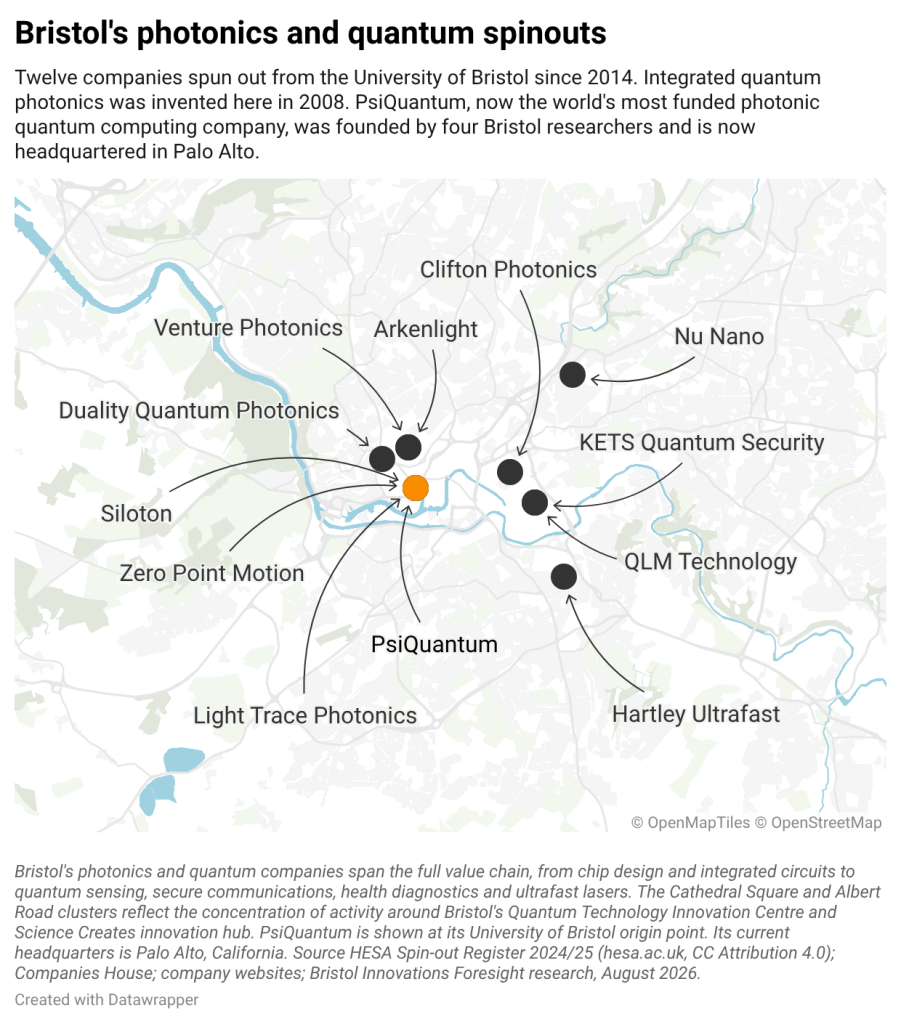
We’ve already talked about O’Brien and a group of researchers in 2008 at the University of Bristol producing the world’s first integrated quantum photonic logic gate on a chip. Today, Bristol can count 12 spinout companies that have followed from that one research group. These include the following;
Three of these companies, Zero Point Motion, Siloton, and Light Trace Photonics, operate from Cathedral Square, the address of Bristol’s Quantum Technology Innovation Centre. KETS Quantum Security and QLM Technology are on Albert Road in St Philips, the same quarter as Science Creates, Bristol’s deep tech incubator. Hartley Ultrafast is at the Paintworks in Arnos Vale. The companies are within a few miles of the university that produced them.
PsiQuantum is the outlier. Founded in 2016 by four Bristol researchers, Jeremy O’Brien, Pete Shadbolt, Mark Thompson and Terry Rudolph, it is now headquartered in Palo Alto and has raised over $1bn. It is the most funded photonic quantum computing company in the world.
One Bristol spinout, Oulton says, is receiving attractive offers from abroad, including from the EU, not just to manufacture overseas but to relocate entirely.
“This company is currently resisting the pull because they want to stay in the UK, but at some point, it might be their only viable option.”
That is still the reality of UK start-ups and scale-ups, but what this sector is showing is that there is a wealth of talent and ideas that in recent years has attracted investment.
In Cambridge there are currently ten photonics and quantum spinouts from the university. Nu Quantum raised $60m in a Series A in 2025 for photonic quantum networking hardware, while Riverlane, a quantum error correction specialist, has become a global benchmark in its field.
In Sheffield, Aegiq builds full-stack photonic quantum computers with its Artemis system, installed at the National Quantum Computing Centre in 2025. In Southampton, the Optoelectronics Research Centre has generated photonics manufacturing companies since 1989. Lumenisity, one of its spinouts, developed hollow core fibre technology and was acquired by Microsoft in 2023.
“Less obvious, but just as important as the translation of quantum physics into a robust product, has been the development of a mature software layer which handles the orchestration tasks between the quantum processor and the classical data centre,” says Murray, whose ORCA system ran at the National Quantum Computing Centre in 2025. “In many instances, this has been the component with the most impact on reliability and product maturity. It’s what most users see when they work with the system.”
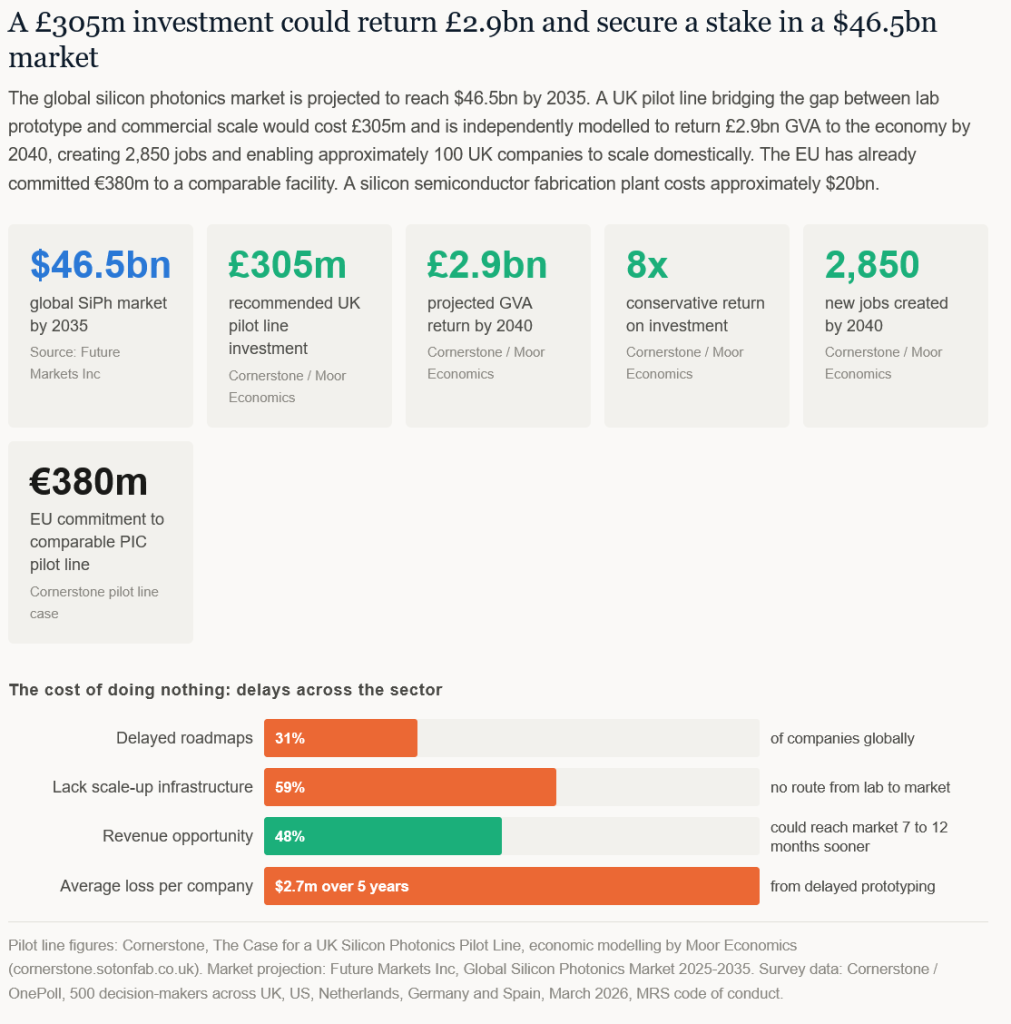
A survey of 500 decision-makers across the UK, US, Netherlands, Germany, and Spain, commissioned by Cornerstone and conducted by OnePoll in March 2026, found that 59% say their country lacks the infrastructure needed to move from research to commercialisation.
Two-thirds say manufacturing access is the primary roadblock, with delays to product roadmaps costing companies $2.7m on average. Nearly half (48%) say they could reach commercial revenue seven to 12 months earlier if prototyping cycles were accelerated by 25%.
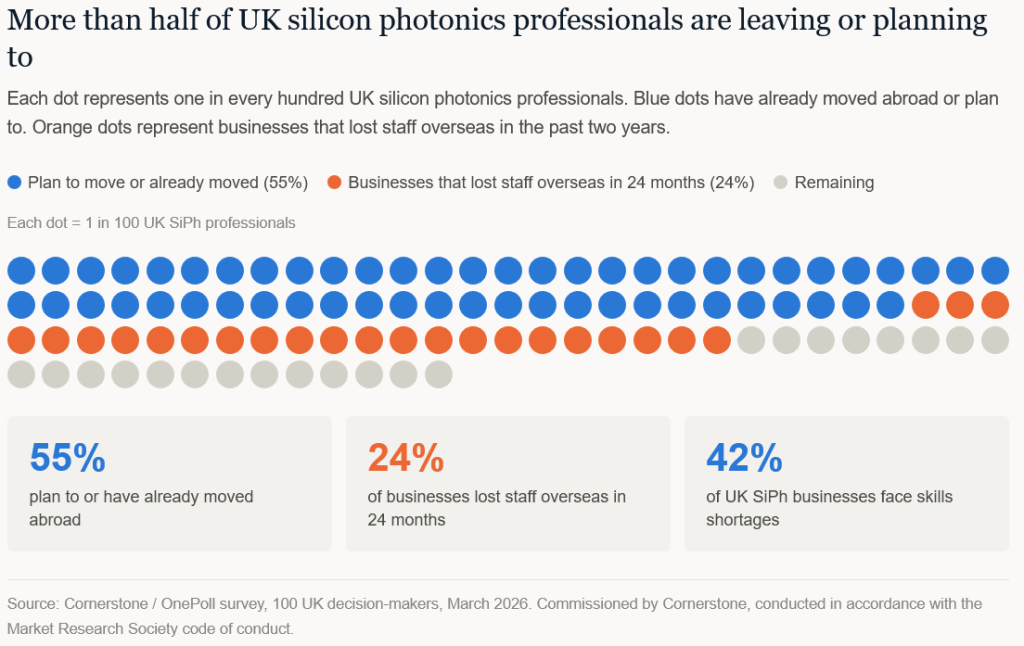
In the UK specifically, 55% of silicon photonics professionals say they plan to or have already moved abroad. A quarter of UK businesses in the sector lost staff overseas in the past 24 months, with 42% saying they face active skills shortages.
“People skilled in photonics are going to be in demand everywhere so they will go where the cost of living and quality of life is best for them,” says Oulton. “I foresee photonic-based AI chips will become more important, which will be another competitor for quantum photonic skilled people.”
John Lincoln, chief executive of the Photonics Leadership Group, challenges the brain drain narrative.
“Twenty years ago yes, many of our best photonics talent went abroad, but even then many returned home and became members of a global UK photonics diaspora that led to significant inward investment,” he says. “There is and has always been a two-way flow. Brexit has created more barriers, restricting this flow. But with high talent visa programmes it remains a two-way flow which benefits all.”

Lincoln makes a good point. The UK continues to attract significant foreign investment and the photonics diaspora has been a genuine asset. But whether talent flows in or out, the pipeline itself needs to grow. The Council for Science and Technology, in its letter to the prime minister, identified gaps in post-16 and undergraduate photonics training and called for specific, time-bound steps to identify, attract, and retain talent. A separate survey by QuEra Computing, published in February 2026, found that more than a third of quantum sector respondents globally cited talent availability as a primary challenge, with UK results specifically highlighting skills shortages as a factor that could limit adoption.
So, the challenge to grow the skills pipeline will, according to Cornerstone’s survey findings, require the industry to focus on the ‘carrots’ to attract new investment and skills into photonics. Top of this list is a pilot line, a shared national manufacturing facility that bridges the gap between laboratory prototype and commercial scale production, something that currently does not exist in the UK.
“You can raise £250m relatively easily, and then you’ve got the problem of where to spend it,” says Sellars. “If you’ve got the infrastructure, the academics, and the skills, then everybody will be pulled into the UK.”
He adds that highly innovative products, such as semiconductors and photonics, often disrupt existing supply chains, causing incumbents to respond by defending their market share.
“Scale-up infrastructure, such as a pilot line, de-risks the scale-up journey,” says Sellars.
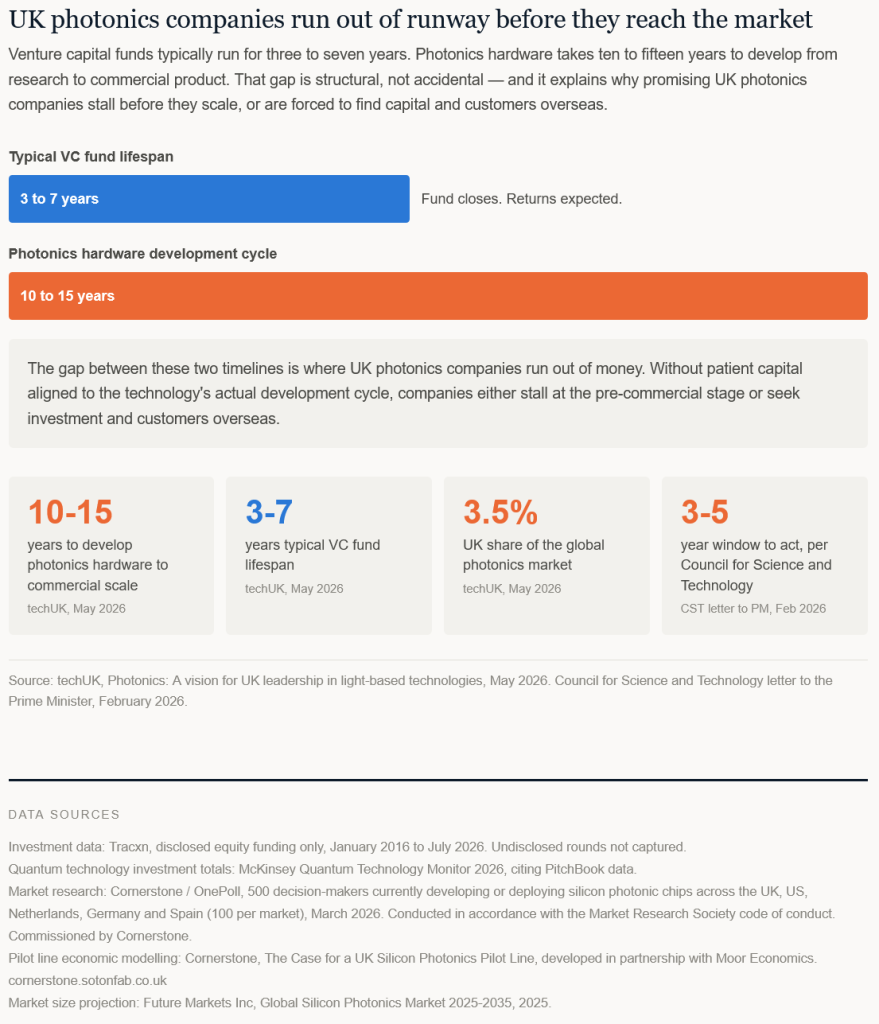
The funding structure compounds the problem. A six-month consultation by techUK, published in May 2026 and drawing on roundtables and workshops with dozens of member companies, identified a persistent mismatch between venture capital investment timescales of three to seven years, and the 10-to-15-year development cycles typical of photonics hardware. Many promising UK innovations stall at the pre-commercial stage as a result, or are forced to scale overseas.
Between a laboratory prototype and a commercially-viable photonic chip sits a manufacturing process that UK companies cannot currently complete at home. Prototype runs at open-access foundries like Cornerstone produce tens of chips, sufficient for research and early development. Commercial volumes require a pilot line.
“Academics and government will not commercialise this technology,” Sellars says. “It has to be profit-driven focused companies that will commercialise it.”
Economic modelling by Moor Economics, developed in partnership with Cornerstone, projects that a UK photonic pilot line would add £2.9bn in GVA (gross value added) to the economy by 2040. It would also create 2,850 jobs, and enable approximately 100 UK companies to scale domestically, generating £4.7bn in cumulative revenues by 2035.
The recommended investment is £305m, which is modest by semiconductor standards (a silicon semiconductor fabrication plant costs approximately $20bn). It has a relatively conservative projected return of more than eight times, too.
It is worth noting that the UK already manufactures photonics at scale. Seagate’s Springtown plant in Northern Ireland has received more than £1bn in investment since 1993 and produces one quarter of the world’s recording heads for hard disk drives using photonic integrated circuits. The capability exists. So the UK has demonstrated it can manufacture photonics at scale, but what it has not yet done is build that capability for the quantum and AI hardware markets.
The same cannot be said for other regions. The EU has already committed €380m to a comparable PIC pilot line. The US has AIM Photonics. Belgium has imec, and France has CEA-Leti.
At a time when sovereign capability in key technologies is at the forefront of national policy, the timing could not be more pertinent. NATO approved a quantum technology roadmap on 30 July 2026, committing the alliance to becoming quantum-ready across computing, communications, and sensing. For UK defence procurement, security requirements already mandate domestically manufactured chips. NATO’s roadmap turns that existing requirement into a long-term institutional commitment across 32 member states. A UK pilot line would be positioned to supply directly into that demand from day one.
“The diversity of photonics is both a blessing and challenge,” says Lincoln at the Photonics Leadership Group. “Firms can choose to apply photonics in areas relevant to their customers and the industries they understand,” he adds, saying that, however, “for policy makers this diversity is a major challenge.”
It perhaps explains why government(s) have found it difficult to wrap photonics into traditional legislative frameworks. Policy, explains Lincoln, is predominantly linear, but given that photonics can have impacts in multiple industries, such as health, defence, communications, transport, and manufacturing, it makes the art of policy more complex.
This range of what Lincoln refers to as “hugely diverse sectors with impact over differing timescales,” means that developing the economic models for return on investment is “a major challenge.” He adds, “Policy often prefers simpler messages… which is why photonics has struggled to get visibility.”
It does, however, feel as if there is a head of steam building. The UK government’s AI Hardware Plan, published in June 2026, specifically names silicon photonics. The March 2026 quantum strategy commits £2bn to strengthen UK quantum capabilities and the Council for Science and Technology wrote to the prime minister in February recommending a national photonics roadmap.
In addition, the EU has proposed a second Chips Act listing integrated photonics as a key enabling technology, while techUK’s own May 2026 report sets out eight recommendations for the UK to be sovereign and competitive in photonics. This includes a National Photonics Roadmap, a dedicated Photonics Patient Capital Fund aligned with the sector’s 10-to-15-year development cycles, use of public procurement to drive photonics adoption through the MOD and NHS, and a taskforce to develop a decision-ready pilot line business case.
The challenge, as always, is to turn all the words into investment and action, with the Council for Science and Technology suggesting this needs to happen with some urgency. The Council gives the UK between three and five years, otherwise it will be too late to compete.
What concerns Murray at ORCA is what he sees as a lack of focus.
“Policy makers haven’t quite read the room and still don’t quite understand the opportunity,” he says. “To do well, it also requires suitably sized investment to make a difference, and it must be focused, and refrain from trying to be too many things to too many people. Neither of these features come naturally to UK policy makers who historically like to spread their bets.”
It’s a good point, but as Sellars at Cornerstone reminds us, the chopping and changing in UK politics in recent years has not exactly helped.
“The decision to invest in pilot line infrastructure is not helped by political uncertainty,” he says. “The formation of DSIT in 2023 delayed the Semiconductor Strategy, and the 2024 pilot line study by the Institute for Manufacturing was followed by the general election. With each delay, the UK slips behind international competition.”
Sellars was part of a government-commissioned study in 2023 on semiconductor infrastructure. The study examined whether Britain should build a gallium nitride pilot line. The study did not recommend immediate action.
“Singapore made a gallium nitride pilot line,” Sellars says. “It’s now operational, it’s making money. So if we had got in there and done something, we’d have made money. And I think the government is now kind of slightly saying, well, okay, we missed out on that, we missed out on a few boats. We don’t want to miss the next boat.”
China’s share of the global photonics market has grown from roughly 10% to more than 30% over two decades. Europe’s has fallen to 15%. Meanwhile, Japan, Taiwan, and the US all send delegations to the UK photonics research base.
“They all see the UK in the same light,” Sellars says. “They all say the UK is the invention house of the world.”
Oulton’s view is that for quantum computing, different countries will end up specialising in different hardware platforms, and the competition for those niches will be fierce. The UK’s photonics heritage positions it well to feed markets regardless of quantum modality, but it needs to get the infrastructure right and it needs to train and keep people in the photonics industry.
Murray agrees. “Building and growing home-grown talent will always have greater benefits than helping international companies set up satellite offices,” he says.
Given the history and the numbers, the UK has earned the right to compete. Now the question is really whether it can capitalise. A history of wasted opportunities in other sectors can cast a long shadow. The PC, the world wide web, artificial intelligence – in each case British researchers were at or near their origin, and in each case the commercial returns accrued elsewhere. The next 12 months will be critical for photonics, if the UK is to ensure photonics does not join that sorry list of nearly achievements.
Note: Sources and methodology
Investment data throughout this article is drawn from Tracxn, covering disclosed equity funding rounds in quantum technology hardware companies from January 2016 to July 2026. Tracxn captures publicly disclosed rounds only; undisclosed funding is not included, which means the figures cited represent a floor rather than a ceiling for each modality. Global quantum technology investment totals are from McKinsey’s Quantum Technology Monitor 2026, which draws on PitchBook data.
Market research figures – covering infrastructure gaps, prototyping delays, revenue timelines and workforce mobility – are from a survey of 500 decision-makers currently developing or deploying silicon photonic chips, or in the planning stages of doing so, across the UK, US, Netherlands, Germany and Spain, with 100 respondents per market. The survey was commissioned by Cornerstone and conducted by OnePoll between 19 and 31 March 2026, in accordance with the Market Research Society’s code of conduct. All participants were double opted in. Data quality controls included monitoring for response patterns, duplicate IP addresses and trap questions.
The economic case for a UK photonic pilot line – including the £2.9bn GVA projection, the 2,850 jobs figure, the £305m recommended investment and the eight-times return on investment – is drawn from Cornerstone’s published analysis, The Case For A UK Silicon Photonics Pilot Line, with economic modelling developed in partnership with Moor Economics. UK photonics industry output, employment and growth figures are from Photonics UK, The Hidden Economic Engine, 2025. Spinout data is from the HESA Spin-out Register 2024/25, published under Creative Commons Attribution 4.0, filtered to active physical sciences spinouts with photonics or quantum connections. Companies not yet in the HESA register were verified independently via company websites and Companies House. The global silicon photonics market projection of $46.5bn by 2035 is from Future Markets Inc. Policy and industry analysis: techUK, Photonics: A vision for UK leadership in light-based technologies, May 2026. NATO Quantum Technology Roadmap, approved 30 July 2026, public summary released 29 September 2026.
Working as a technology journalist and writer since 1989, Marc has written for a wide range of titles on technology, business, education, politics and sustainability, with work appearing in The Guardian, The Register, New Statesman, Computer Weekly and many more.