Artificial Intelligence
Future Telecoms
Quantum
Wise words and waggishness… October 2026
Reading time: 2 mins
The UKRI Quantum Showcase in London drew 4,000 people to Islington, but is growing interest in the tech translating into real business?

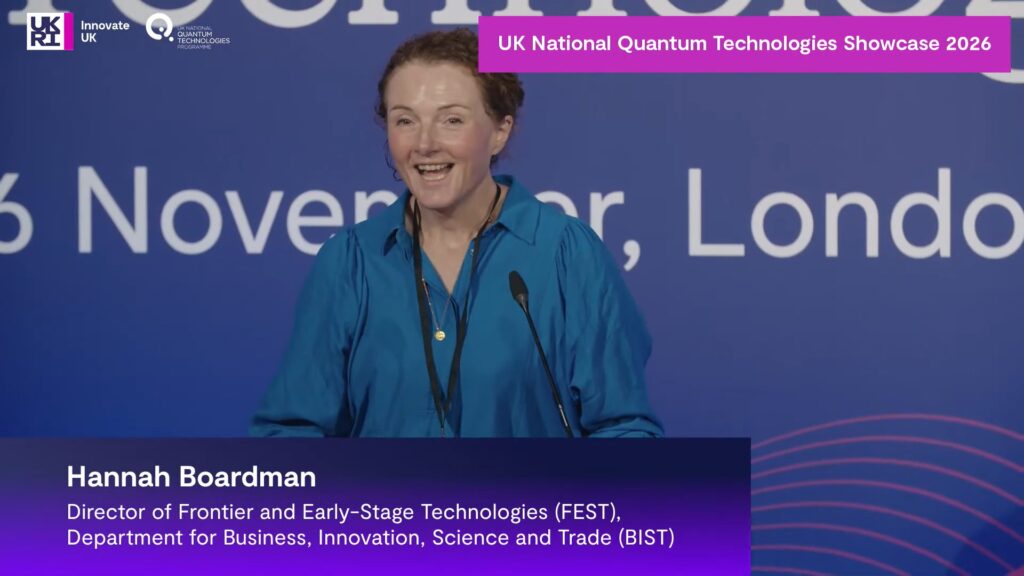
“Government must do more than support innovation at the beginning of the journey,” said Hannah Boardman, director of frontier and early-stage technologies at the Department for Business, Innovation, Science and Trade (BIST).
Boardman was introduced as one of the “BISTo Kids”, a nod to the gravy adverts from the ’70s and to her new department, formed in July when UK PM Andy Burnham folded DSIT into the business department. The commitment to quantum, she said, had come through the change of government “stronger than ever.”
ProQure, with up to £1bn set aside to buy large-scale quantum computers in the early 2030s, is perhaps proof of that. So is £138m for quantum sensing procurement across government, announced in the Budget, including £30m from the Ministry of Defence, its largest quantum investment to date. The showcase added £35m for quantum networking testbeds, a £12m quantum commercialisation skills centre led by Imperial College London, and confirmation that the MoD will publish a Defence Quantum Action Plan in the new year. But as Boardman said, government demand can help create a market but “it cannot be the whole market.”
Quantum has always faced questions about who will use it. Two years ago at this event, Sir Peter Knight told us the industry needed “end-to-end products that do not require a deep understanding of quantum physics to use”, along with “patient capital investment and partnerships with government departments.” The UK government has gone some way to address this but what about the private sector?
Recent figures from Beauhurst show that UK quantum companies raised £587m across 23 deals in the first half of 2026, more than in 2024 and 2025 combined. Close to half came from a single round, OQC’s £260m Series C. On venture money the UK is second only to the US. Preqin puts UK quantum VC since 2017 at $3.1bn, against $8.4bn for the US.
Two of the largest names in US quantum started in British labs. PsiQuantum, which raised $1bn in a single round in September 2025, was founded by physicists from the University of Bristol and Imperial College London, but set up in Palo Alto. Quantinuum, which raised $1.68bn on Nasdaq in June, grew partly out of Cambridge Quantum, founded in the UK in 2014 and merged with Honeywell’s quantum business in 2021.
Chris Elphick, head of venture capital at UK Private Capital, warned against this happening again, saying that if founders have to move to the States to grow, the value created here goes with them. Capital alone will not hold them, he suggested, adding that “the procurement question has come up every year.”
Quantum companies need customers, and as Boardman said, those have to come from beyond government.
Tom Adeyoola, executive chair of Innovate UK, described what he sees as a customer gap in the UK market. He referenced an investor he had heard at a breakfast meeting that morning who had complained that one of their companies had made sales all around the world, but not in the UK.
“That is a problem we really need to fix, and it’s something that I’m certainly grappling with,” said Adeyoola with welcome honesty.
NatWest has spent nearly four years testing whether quantum computing can help it catch money launderers, mule accounts and fraud. It has worked with IBM, entered hackathons at the National Quantum Computing Centre (NQCC), and joined the Quantum Technology Access Programme run by Digital Catapult and the NQCC. It is still a trial, and the trial has raised its own questions about where the data goes, who else can reach it, and what standards should apply. These are all big questions for a heavily regulated industry.
For Dave Starling, head of future products technology at NatWest, quantum has huge potential but it is one piece of many moving parts. Compliance is a big concern, as is buy-in from across the organisation.

“When I’m talking to our security team and saying, ‘Hey, look, we’re doing some really interesting work in the quantum space, can we start a conversation about what productionisation looks like?’, their eyes glaze over a little bit, and they start asking what data we are transferring and where does it sit,” said Starling.
He wants banks and quantum companies to agree common security standards, drawing on the past few years of work on AI, but it is clearly not easy.
“I don’t think we’re starting from zero, but I would say we’re not halfway there yet,” he added, illustrating a key challenge facing many quantum customers in financial services.
Some help is coming from the regulator. The day before the showcase, the Financial Conduct Authority (FCA) announced a Quantum Experimentation Group, in which firms will compare quantum and classical methods for detecting financial crime on a synthetic dataset the FCA has built. It starts in early 2027.
Vodafone’s obstacles are different. Its biggest problems, such as where to route fibre and place mobile antennas across a national network, need “really quite large, heavy quantum computers,” said Ryan Parker, Vodafone’s quantum team lead. Today’s machines can run proofs of concept, but they can’t handle the real thing.
Data is the second problem. UK telecoms security law limits where network data can go. Synthetic data is one answer, said Parker, but it has to behave like the real network.
The third obstacle is how operators buy products and services. Parker says it’s “often easier to sell via our vendors that we already work with, so like Ericsson, Nokia, Huawei, Cisco.” For a start-up, the route to Vodafone usually runs through one of them, or not at all.
“We can’t fail fast,” said Emil Tschepp, senior engineering leader at Transport for London (TfL), explaining why its trial of quantum magnetometers alongside inertial sensors on the District line has been running since 2022.
The aim is for a train to know where it is without satellite signals or equipment along the track. GPS does not work underground, and conventional sensors lose accuracy over time. Quantum sensors are far more precise and could replace much of the cabling now used to track trains.
But as Tschepp said, it is still a trial. Approvals and safety assurance takes time. TfL engineers need to build a safety case, using data from the quantum sensors running in the background.
For Siloton, the Bristol company putting an eye scanner on a photonic chip, medical device regulation is “not as hard as it may seem”, said Ben Hunt, the company’s co-founder and chief commercial officer, because the routes to approval are well mapped. Selling into the NHS is much more difficult.
Between the company and the clinician who wants the scanner, there is “almost always” a procurement team or an insurer. Siloton’s in-clinic scanner is due in early 2029, backed by an £8.4m UKRI contract. Its chief executive, Alasdair Price, told BI Foresight that NHS procurement is “very, very, very slow.”
There was, however, plenty of optimism. While Boardman says “we need to see adoption” there are enough trials in motion to suggest some proofs of concept will emerge in the coming months. For Costantino Mariella, senior investment manager at the British Business Bank, FOMO may start to play a role among potential customers.
Wishful thinking? Perhaps.
Working as a technology journalist and writer since 1989, Marc has written for a wide range of titles on technology, business, education, politics and sustainability, with work appearing in The Guardian, The Register, New Statesman, Computer Weekly and many more.