
Artificial Intelligence
Future Telecoms
Life Sciences
Quantum
Robotics
Latest tech trends: what McKinsey says about quantum, robotics, connectivity and life sciences
Reading time: 6 mins
Two of the six companies dominating Britain’s deep tech funding don’t do AI research, or any research. We look at the latest Tracxn report

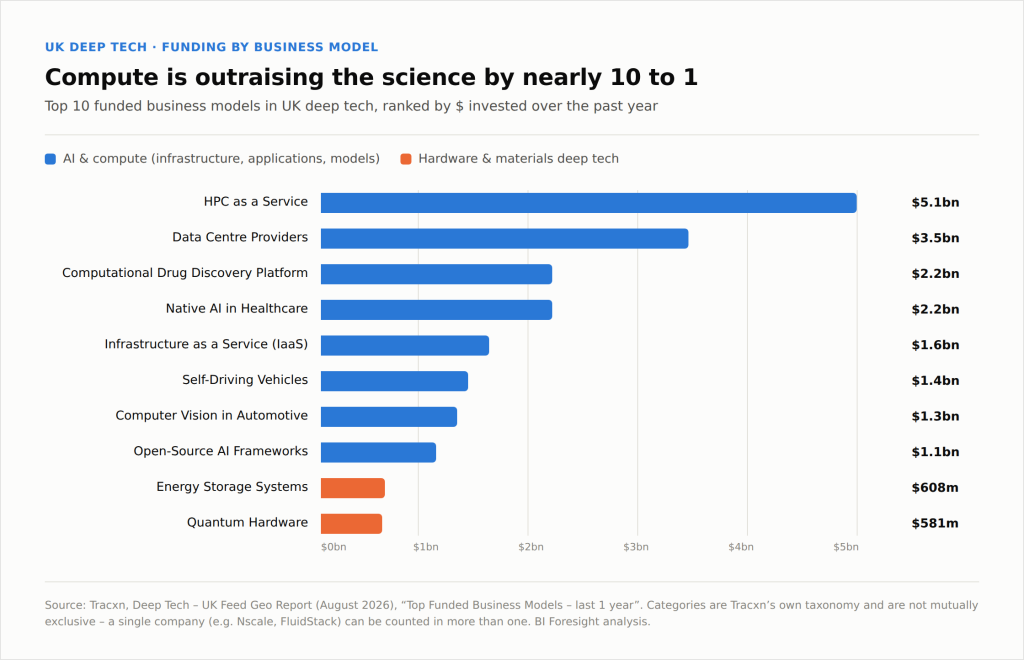
UK deep tech has raised $11.3bn so far this year, a record, against $6.4bn for the whole of 2025, according to the latest figures by global data intelligence firm Tracxn. While on the surface this may seem like good news, the reality is that funding is dominated by AI infrastructure, not science start-ups.
A prime example of this is Nscale, founded in 2023 as a data centre operator that rents out clusters of Nvidia chips to companies needing somewhere to train and run AI models. FluidStack, a UK-founded company that moved its HQ to the US last year, does much the same. Both accounted for $5.5bn in total funding.
Further down the same list, quantum hardware has attracted $581m over the same period. Energy storage, the category behind Fidra Energy’s grid batteries, sits at $608m. Compute dominates but it isn’t the whole picture.
Compute is outraising the science by nearly 10 to 1. Renting out GPU racks pays back within a year or two; a quantum processor might take a decade. For the moment at least, infrastructure is seen as a less risky punt.
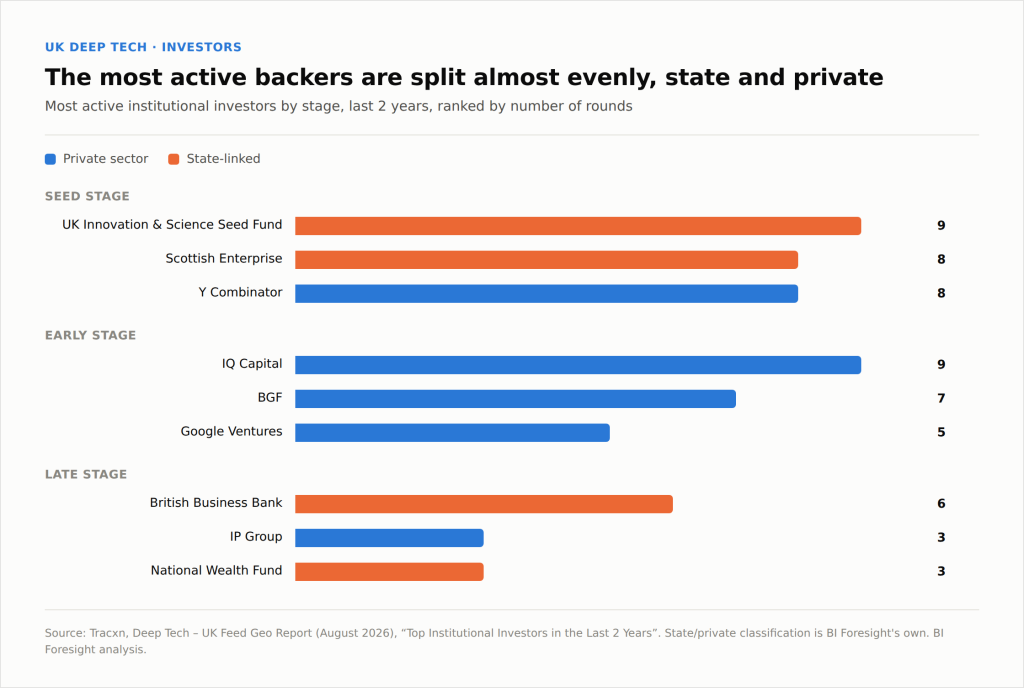
The most active backers of UK deep tech split almost evenly between state and private money. State funders are most active at the earliest stage, before there’s much to judge, and again at the latest, largest rounds. Private VCs cluster in between, once a company has a track record to assess.
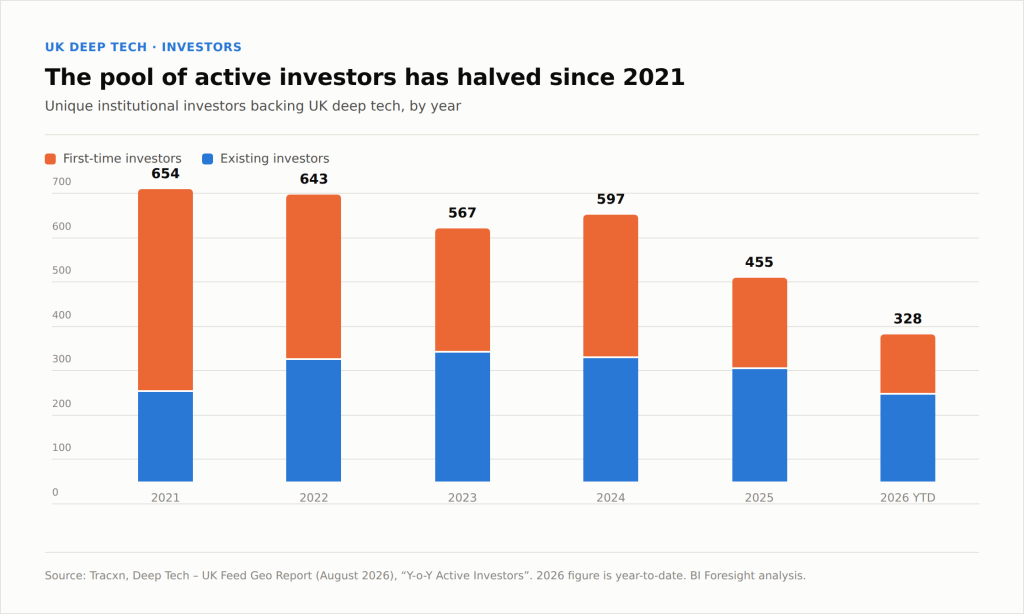
The pool of active investors backing UK deep tech has halved since 2021. With total funding still climbing, fewer investors are placing much larger, more concentrated sums.
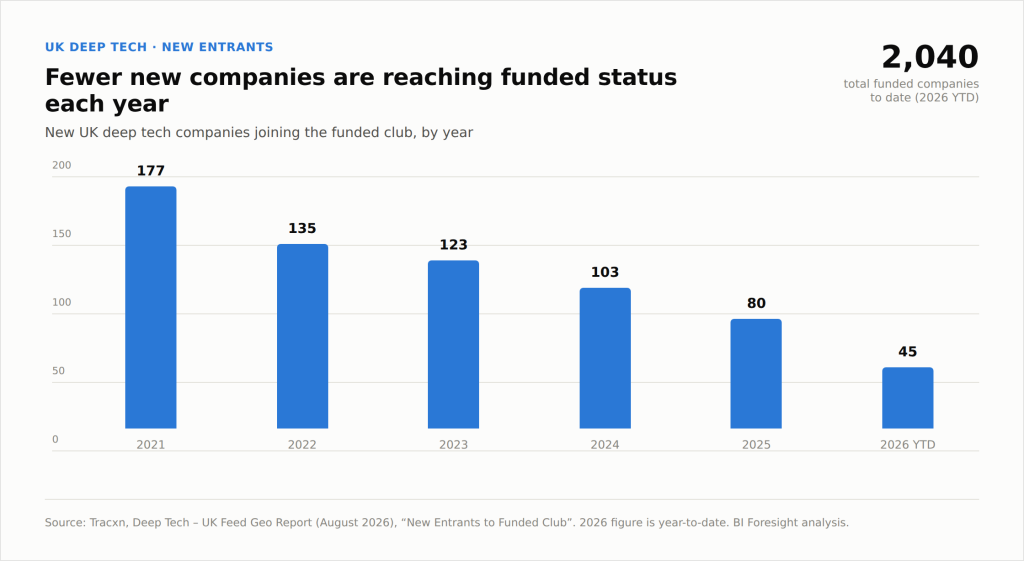
Fewer new companies are reaching funded status each year, even as the total keeps climbing. A record year for money isn’t the same as a record year for new companies getting a look in.
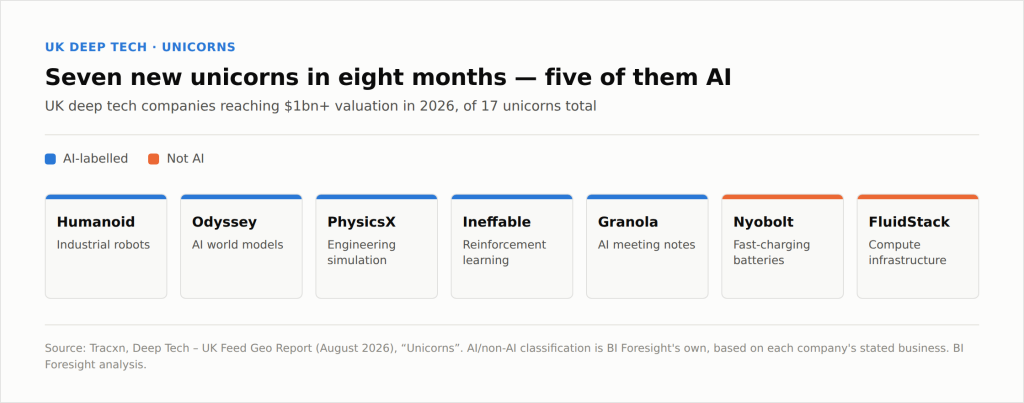
Five of the seven UK deep tech unicorns minted in 2026 are AI companies. The AI label is pulling in the money and producing the fastest, most visible successes too.
The Royal Academy of Engineering’s Spotlight on Spinouts 2026 puts the University of Bristol fourth nationally for spinout value creation and sixth in Europe: 46 VC-backed spinouts since 2010, worth £8.5bn combined, the highest total of any UK institution outside Oxford, Cambridge and London.
Two facilities have opened in Bristol this year, offering the kind of long-lease lab space a fusion, quantum or battery-chemistry spinout needs long before it can afford its own. These are OMX, a 30,000 sq ft incubator run by Science Creates and the University, and the University’s Temple Quarter Enterprise Campus, home to the new Bristol Innovations Zone.
Sources: Tracxn, Deep Tech – UK Report and Feed Geo Report (August 2026); Royal Academy of Engineering, Spotlight on Spinouts 2026; University of Bristol, Bristol welcomes new scale-up lab space as the UK’s top deep tech city outside the Golden Triangle (January 2026).
Working as a technology journalist and writer since 1989, Marc has written for a wide range of titles on technology, business, education, politics and sustainability, with work appearing in The Guardian, The Register, New Statesman, Computer Weekly and many more.