
Artificial Intelligence
Future Telecoms
Quantum
Wise words and waggishness… September 2026
Reading time: 2 mins
UK is pinning growth hopes on backing innovation. That means renewed focus on funding and collaboration, even across borders

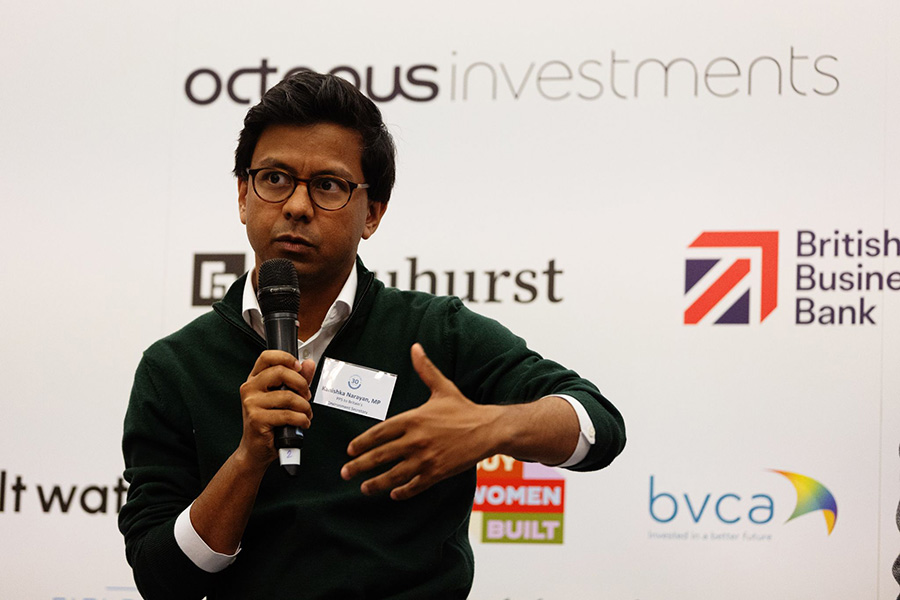
Four days into Andy Burnham’s government, Britain has got a new AI Taskforce, chaired by former Science Minister Lord Vallance. Kanishka Narayan, who kept his job as AI Minister through the cabinet reshuffle, runs it day to day with a brief from the new Prime Minister for AI to “power a new industrial revolution that drives good growth in every postcode.”
Back in February, at Founders Forum’s London AI Hub, Narayan said that “before we can steer the wheel, we need to get to the front of the bus.” No working-age person in Britain, he pointed out, has seen a home-grown start-up reach the FTSE top ten. In the US, eight in ten have.
Of course, we are talking about two very different economies. Yes, there has to be ambition but there also has to be reality. Britain innovates well in its universities but the question is, which of those innovations end up carrying the weight of that ambition? And where does the money and opportunity come from to help those companies scale?
To that end, Burnham’s embattled predecessor Sir Keir Starmer kickstarted a negotiation with President of the European Commission Ursula von der Leyen back in May, for Britain to get access to a new €5 billion fund that wants to provide late-stage funding to tech companies. Final decisions have yet to be made.
In terms of focus though, life sciences has proven to be the largest sector for UK University spinouts by a wide margin. The sector can boast 407 venture-backed companies since 2010, worth a combined £26.7 billion, according to the Royal Academy of Engineering’s Spotlight on Spinouts 2026 report. Quantum is a fraction of that size by company count, with just 22 spinouts, yet those 22 have created £7.9 billion in value, more than semiconductors, robotics, and space combined.
AI, by contrast, has produced 187 spinouts worth £8.4 billion, a somewhat broader base, but a lower return per company. To be fair, AI companies are difficult to categorise in the same way, as most start-ups are using AI to solve problems in specific fields, such as CuspAI in materials discovery or even Graphcore in developing AI processors.
Regardless, for the UK, focusing investment on a few sectors makes a lot of sense. Eleven days before the AI Taskforce launched, UK Research and Innovation (UKRI) published a new five-year strategy for its £38.6 billion budget, focusing on AI, quantum, clean energy and life sciences.
Rosalind Gill, policy director at the National Centre for Universities and Business, welcomed this choice of priorities saying it is “never easy” and adding that “at a national level, having greater clarity about where the UK can build globally competitive advantage has the potential to create stronger partnerships, attract investment, and accelerate growth.”
The Royal Academy of Engineering gave the strategy its own endorsement, welcoming what its president called “the realism and prioritisation” in UKRI’s approach.
Picking sectors is one half of the argument. The other is where in the country those sectors actually get to grow, and here the Academy’s own data tells a more encouraging story than the funding figures alone suggest. UK spinout activity, its report finds, “is becoming increasingly geographically diverse, with strong growth beyond the Golden Triangle” of Oxford, Cambridge, and London.
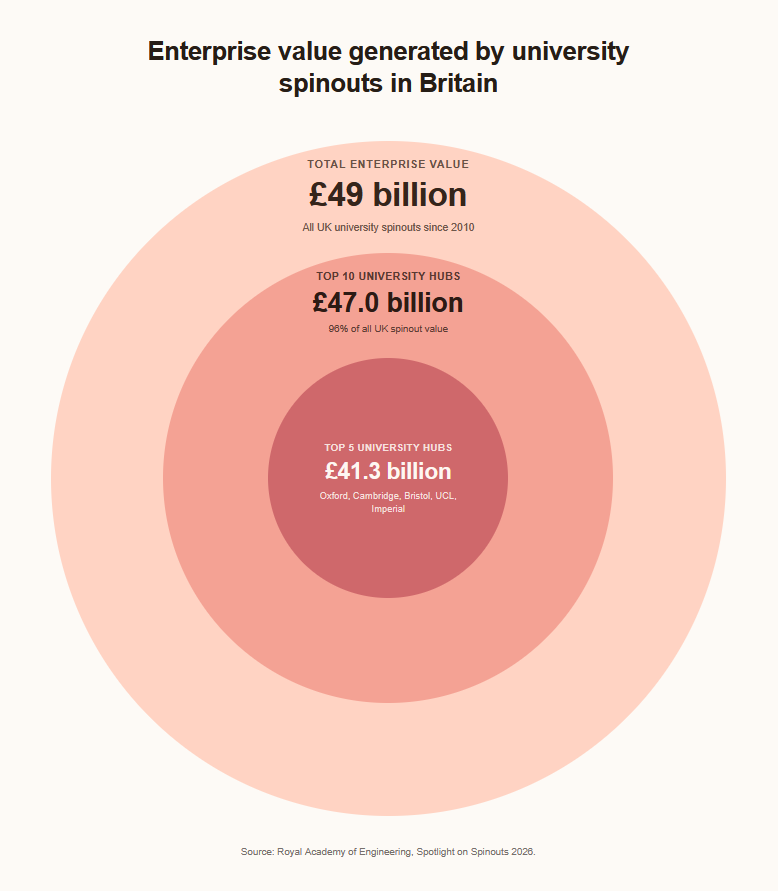
The University of Bristol is clear evidence of this. It ranks fourth in the UK and sixth in Europe for spinout value creation (the highest-placed university outside the Golden Triangle) with 46 venture-backed spinouts since 2010 worth a combined £8.5 billion. Manchester, Sheffield, Dundee, Nottingham, and Queen’s University Belfast all feature in the same top-20 table, evidence that value creation no longer runs through three postcodes alone.
But the scale-up problem is universal. University of Bristol and Imperial College spinout PsiQuantum, now based in the US, has raised $2.6 billion and was valued at $7 billion in June 2025. Also, Graphcore, Bristol’s AI chip company, was acquired by Japan’s SoftBank in 2024 for £470 million.
The Royal Academy of Engineering’s own table of the ten largest UK spinout acquisitions of the last decade reveals that every single buyer is foreign. Abcam, a Cambridge protein-research spinout, sold to America’s Danaher for £4.5 billion in 2023. Oxford Ionics, a trapped-ion quantum computing spinout, went to US-based IonQ for £840 million this year. OrganOx, an Oxford medical devices company, sold to Japan’s Terumo Corporation for £1.2 billion. Cambridge’s Gyroscope Therapeutics went to Switzerland’s Novartis. Dundee’s Exscientia went to America’s Recursion Pharmaceuticals. Life sciences and quantum companies dominate the list but not one of the ten went to a British acquirer.
Funding has been a recurring problem, and Britain cannot compete with the US on scale. But lessons are being learned. The government’s approval of IonQ’s $1.075 billion acquisition of Oxford Ionics under the National Security and Investment Act has been framed as a landmark decision and a potential blueprint for how Britain manages strategic exits in the future.
The deal was cleared only on the condition that Oxford Ionics’ hardware stays hosted in the UK and its core science, engineering, and intellectual property functions remain onshore. It is the kind of intervention that can build a stronger domestic base and, in turn, boost the confidence of the investors funding the next one.
Given that UK spinouts raised £1.3 billion in venture funding in 2025, the lowest figure since 2021, according to the Royal Academy of Engineering, this is perhaps a good thing. However, funding for the rest of UK tech grew 46% over the same period, driven by AI and a fintech recovery.
A separate analysis from Beauhurst and Penningtons Manches Cooper found the 2025 slowdown in spinout deal sizes “marks a departure from the wider UK equity market, where total investment and average deal sizes increased in 2025 despite a fall in deal numbers.”
The rest of British tech got more selective and was rewarded with bigger cheques. Spinouts, young and IP-heavy, were exactly the kind of asset investors turned away from – but could that change?
British tech companies raised $15.3 billion in the first half of 2026, according to Tracxn, up 84% on the second half of 2025, even as total funding rounds fell over the same period, from 543 to 490.
Four deals of $1 billion or more happened in the first half of 2026, against just one in each of the two halves before it. Three companies, Isomorphic Labs, Nscale, and Wayve, accounted for roughly a third of all the capital raised in Britain this year. All three are considered AI companies.
Meanwhile, London’s share of UK tech funding rose to 86%, up from 79% the previous half, even as cities like Bristol, Manchester, and Edinburgh grew off smaller bases.
What this all calls for is greater coordination, which, to be fair, is something the government is trying to do. Nowhere has this been more obvious than in the push for more sovereign technologies. Sovereignty is becoming a well-worn phrase these days, complicated by legacy technologies and a need to work with partners. Britain was never going to build a fully self-contained AI and semiconductor industry from scratch, competing against economies many times its size. The government seems to know this but as Dame Chi Onwurah, chair of the Science, Innovation and Technology Committee, warned recently, the government risks “having its access cut off at the whim of its partners” without a clearer plan for sovereign capability.
Weeks before Starmer resigned, Britain signed the UK-Japan Frontier Technology Partnership, an £18 billion package covering AI, quantum computing, civil nuclear, and defence. This also included a formal manufacturing link between the UK Semiconductor Centre and Japan’s Rapidus, and continued commitment to the Global Combat Air Programme, the joint UK-Japan-Italy fighter jet project.
As Starmer said last year, the UK’s ambition is to be “AI makers and not just AI takers,” an ambition which remains but also recognises the need for partners. The UK cannot build every layer of the stack alone, which makes for a healthier, less protectionist market.
All of this is good news for spinouts. Conditions are changing and as a Dealroom report suggests, things are looking up. The UK venture capital innovation forecast shows a strong market rebound, led by artificial intelligence, late-stage megarounds, and deep tech. Start-ups raised $7.8 billion in Q1 2026 alone, a 60% increase year-on-year. The money is coming back, but whether it stays in British hands remains to be seen.
A consortium of major UK pension providers announced on 27 July that they are exploring a UK Scale-up Fund of more than £1 billion, working with the British Business Bank, to back high-growth British science and technology companies.
The consortium includes Nest, Railpen, LPPI, LGPS Central and Border to Coast. Nest chief executive Ian Cornelius called it a role for “patient capital” in helping successful UK businesses access the funding they need to grow.
Dr Joe Marshall, chief executive of the National Centre for Universities and Business, welcomed the move, saying success “will depend on connecting long-term investment with the UK’s outstanding research and innovation strengths,” and that “no single institution can achieve that alone.”
If it goes ahead, it would be the first fund of its kind aimed squarely at the stage where Britain has repeatedly lost its own spinouts and scale-ups abroad. It currently remains only a proposal, but it is a clear sign of intent.
Working as a technology journalist and writer since 1989, Marc has written for a wide range of titles on technology, business, education, politics and sustainability, with work appearing in The Guardian, The Register, New Statesman, Computer Weekly and many more.