Artificial Intelligence
Future Telecoms
Life Sciences
Quantum
Robotics
Latest tech trends: what McKinsey says about quantum, robotics, connectivity and life sciences
Reading time: 6 mins
Quantum fund can accelerate groundbreaking binoculars style scanner development but there are procurement hurdles approaching

“We see this as a once-in-a-lifetime opportunity to change the way the NHS adopts new technology,” says Alasdair Price, co-founder and CEO of Bristol start-up Siloton.
To be fair, the NHS is ripe for changing. By its own admission, it needs to do better. The NHS spends around £10bn a year on medtech, but last year the Department of Health and Social Care admitted it has historically bought on cost rather than effectiveness.
For Price, this is about more than one company or one device. The more important point, he says, is not carrying the flag for quantum so much as carrying the flag for deep tech, med tech, and how those get into the NHS. If Siloton can find a faster way in, he argues, other technologies and companies could also benefit.
It is an interesting test case. The Contracts for Innovation: Quantum Sensors and PNT Missions Primer initiative was set up in May last year. It aims to speed up the development and adoption of quantum sensors and quantum navigation and timing, in support of Missions 3, 4, and 5 of the National Quantum Strategy.
Siloton was one of six companies backed by UKRI this month. Its £8.4m contract will pay for clinical trials of its handheld eye scanner at Sunderland Specialist Eye Hospital, which will run through to completion. Regulatory approval should follow about six months later, and Price expects to launch an in-clinic version in early 2029.
Price is confident that approval will not be a problem. Siloton can point to existing optical coherence tomography (OCT) systems as precedents, which should shorten the regulatory process.
OCT, as Siloton describes it, uses light “to create detailed pictures of the inside of the eye,” helping clinicians identify conditions and monitor how they progress. The systems are large and expensive, and are typically found only in hospitals and optometry clinics. That limits access, the company says, particularly for people in rural and remote areas.
Ophthalmology is the busiest NHS outpatient specialty, with around nine million attendances in England in 2023/24, according to Siloton. At the end of July, nearly 623,000 people were waiting for an appointment, 8.7% of all NHS waits.
Siloton’s answer is GiraffeOCT, a binocular-style system that compresses “a tabletop’s worth of heavy, expensive, and fragile components onto a single chip smaller than a £1 coin.”
The aim is to make diagnosing and monitoring treatable retinal diseases cheaper and more accessible, in a clinic or at home.
“A lot of people make this assumption that it’s the regulatory side that makes it difficult to sell to the NHS, and it’s not that at all,” says Price. “The regulation isn’t a problem but NHS procurement is very, very, very slow.”
One consequence of a slow buying process is that companies start looking to sell in the US, says Price. And this, in turn, leads to those companies scaling in the US where they can get funding to meet that market demand. If the UK can improve its market opportunities and speed up the buying process, it will go some way to stem the flow.
Ultimately, Price sees the contract as a chance to change things.
“If through the quantum programme we can find the route to accelerate that adoption, then that can be rolled out across lots and lots of other technologies,” he says.
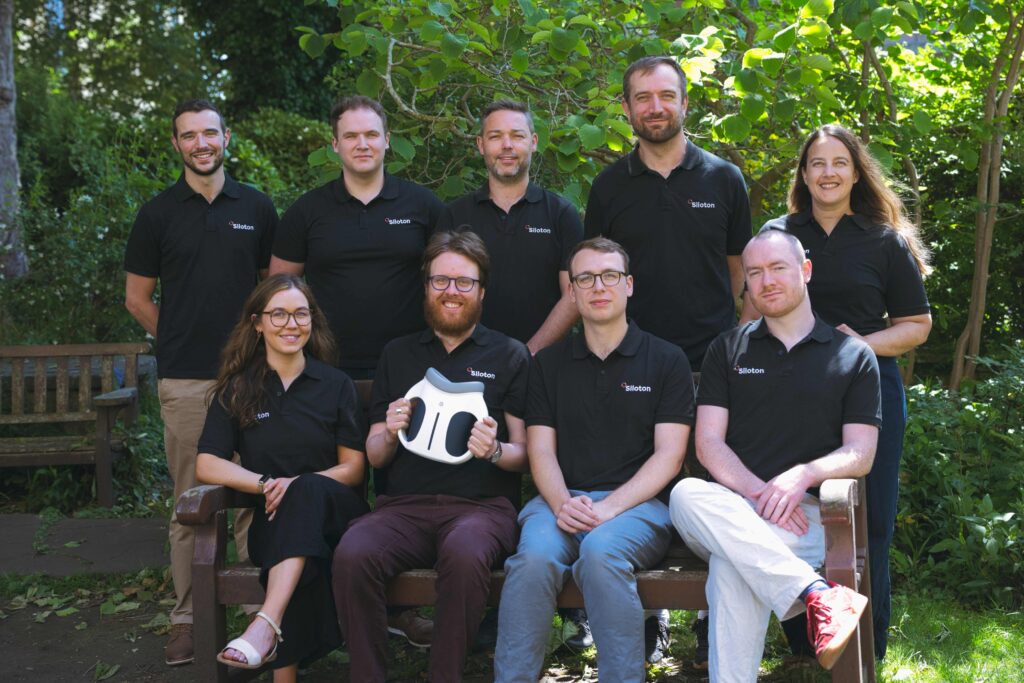
The contract has also given Siloton the confidence to forge ahead with its own plans. The company moves into the Sloane Robinson Building on the University of Bristol’s new Temple Quarter Enterprise Campus next month, where the labs can be reconfigured as the team and its needs change.
Price says that rather than bringing any pressure, the contract has given the company an opportunity “to accelerate our development,” adding, “for a long time, cash has been the bottleneck.”
The plan is to grow the team, bringing in the skills Siloton has so far gone without. That includes electronics engineers that can work on miniaturising what Price describes as “a massive base station” packed with off-the-shelf electronics. There will also be roles covering photonics and software development.
According to the company, its work with Sunderland Specialist Eye Hospital will give patients across the North East and North Cumbria access to the technology during its development. York Health Economics Consortium will also use this data to refine their cost-saving estimates for the NHS. And Silton expects to knock two years off its development plans in the process.
The aim is to manufacture in volume by around 2028, so supply chains, quality control processes and further medical device standards need to be worked out now.
Siloton’s chips are made by an external foundry, and the company currently assembles its scanners in-house. Within about six months it will decide whether to build its own production line or work with a nearby assembly partner.
“You always take some risk if you partner with somebody, because if their quality isn’t up to standard, you end up with some really severe issues,” says Price. “But on the flip side, they can scale up way faster than you can.”
A hybrid setup is more likely, with a partner making sub-assemblies and Siloton testing and finishing the final system. Manufacturing also widens the range of jobs on offer.
“If you don’t need a PhD in quantum physics to do the job, generally it’s a bit easier to find people,” he says. For specialist roles, the difficulty is reaching candidates rather than a lack of them.
He adds that Bristol’s history in photonic chips and processor design gives the company a local pool of talent.
The contract should also help Siloton raise money. Price says investors have become wary of start-ups of Siloton’s age. Some have phoned to check the company isn’t one of those making “a frantic last attempt to raise the money” before going under anyway.
“There has already been an enormous amount of due diligence on what we’re doing,” says Price, adding that while investors will still do their own checks, the government contract is, to a large extent, a stamp of approval.
Its work with the European Space Agency (ESA) adds to that. Siloton’s ESA contract, to monitor astronauts for a condition that damages sight on long missions, has funded its next-generation chip. The design has now gone to the foundry.
“The conditions people suffer from on Earth are different to the conditions you get from going to space,” Price says, “but the bits of the eye you need to look at are the same.”
That chip will shape the specification of the final medical device, and the need for it to be quantum comes down to physics.
“If you need to detect very low levels of light, which we do, you need a quantum sensor,” Price says. “There’s no alternative to that other than just not doing it.”
The prize is an NHS deal. The government has committed to quantum sensing in NHS trusts by 2030, and Siloton’s in-clinic scanner is on course to launch about a year before that deadline. Whether trusts can buy it in time depends on the procurement system Price wants to change.
“The ageing population doesn’t just mean the people with health problems are growing,” he says. “It also means the people who are there to treat them are shrinking.”
Clinicians are already stretched. They need help from new technology and devices to close clinical gaps. Helping the NHS help itself is clearly on Price’s agenda, but the decision to buy rests with trusts working within a system that has long rewarded the cheapest option. Siloton now has two years and £8.4m to build the case that its scanner, at least, is worth more than the price the NHS will hopefully pay for it.
Working as a technology journalist and writer since 1989, Marc has written for a wide range of titles on technology, business, education, politics and sustainability, with work appearing in The Guardian, The Register, New Statesman, Computer Weekly and many more.